Friday, 14 September 2012

Rainy Afternoon Grouse

 “The physics of beauty is one department of natural science still in the Dark Ages. Everybody knows that the autumn landscape in the northwoods is the land, plus a red maple, plus a ruffed grouse. In terms of conventional physics, the grouse represents only a millionth of either the mass or the energy of an acre. Yet subtract the grouse and the whole thing is dead. An enormous amount of some kind of motive power has been lost.” – Aldo Leopold, A Sand County Almanac”

In the quote above, Aldo Leopold was writing about Ruffed Grouse, here in Wyoming I hunt Blue Grouse.  Hunted behind a dog, blues are not all that different from their ruffed cousins. The blue grouse is a bit larger, probably a bit slower, and possibly dumber - but they inhabit the same kind of cover as the ruffed grouse and they perhaps hold a bit better for a dog than a ruffie does.  In terms of their ability to escape from danger - they are no less wily, they somehow always manage to put a tree between themselves and the hunter before they embark on their  thunderous escape.

Blue grouse hunting starts on September first in Wyoming. It's the first bit of the hunting season. For me, there is a nice symbiosis between grouse hunting and hunting for deer and elk.  Grouse tend to inhabit the edges of the best elk habitat and they live in the same country mule deer do.  This means that a grouse hunt is more than a casual deer and elk scouting trip. And it works the other way as well, I have found my best grouse coverts by noticing birds while hunting deer and elk.


Hard work on a rainy afternoon in the grouse coverts.
One day earlier this week Mike and I managed to get away from work a few hours early to hit some favorite grouse coverts.  I prefer to not say which day that was. We did not plan on the rain - hell, it hasn't rained here in weeks.  Never mind, I followed Erdos carrying the new Sidley 20GA SxS and Mike followed his setter Luna carrying one of a pair of 16GA Woodwards. We got into birds, big males in one covert and some young of the year in another.

Mike and Erdos in good cover. Where Luna?
The grouse theorists pretty much all say that at this time of year the big males will be up high and the young of the year down lower near water.  It's all about the altitude - when you find birds - stay at that level and you'll find more.  This theory may make perfect sense along the Front Range in CO where the forest starts around 6000 feet and goes up to around 10,000 in a kind of continuous rise.  Here in southeast Wyoming, the forest starts around 7500 feet and in large areas there is not a lot of elevation gain or loss for many many square miles.  There are grouse there and they don't migrate up or down as much as the biologists might have us believe.  I think they a re more keyed to water than altitude in these areas.  Once the snow flies, they are freer to find the big Firs they like for winter cover. My evidence is that I tend to find grouse year round in the same spots every year and it seems to have little to do with altitude.  Where I mostly hunt - it's all high - around 8000 feet or more.


Sidley 20GA with a brace of Blues.
In the first covert Mike and I hit we got into a large covey of big male birds. There were at least eight birds, maybe more, I lost count.  I only managed one bird there though a good shot might have had her limit and an unethical hunter even more than the allowed three.  The bird I shot was a big male as were the others in covey - or so I believe. In the second bit of cover we hit, one I had never hunted before but which looked good, Erdos went on point and a bird flushed as I moved up. It uncannily managed to perfectly place a tree between me and his escape.  As the bird exploded out of the cover, I shot the tree and the bird flew off unharmed.  And then, for the first time this year, Erdos did not run off after the escaping bird. He has a great nose but he suffers from having had a poor trainer. (That would be me.) When he does run off after a bird he bumps the others in the covey on his way and I am reduced to watching them all bombing up and flying off into the distance. A beautiful sight - but not the one I hope for.  This time, with some serious urging from me, he stayed with me.  He pointed another bird quite nearby and as is flew up I managed to cleanly drop a mature female.


Mike and Luna with a brace of grouse.

On the way out, we spotted a covey crossing the road.  We stopped and moved in on the birds and  Mike managed some nice shooting and dropped two birds on the wing as darted off between the pines.

*                               *                               *

Even though all of us, dogs and men, got very wet, it was a wonderful afternoon.  The symbiosis of the grouse and elk hunt was working too, in anticipation of upcoming elk seasons, we spotted two nice bull elk on the drive out.


Sunday, 9 September 2012

Gun Trading

Trading is a great way to do business, no money exchanges hands and (hopefully) everyone gets what they want. The problem is finding someone who has what you want and is willing to pass it on and that same someone must want something you have and that you are willing to give up.

W. R. Sidley, 20 GA British boxlock  with 30" barrels and chambered for 2 1/2" shells. 
Recently, Stephen Bodio and I have been corresponding about guns, hunting and life in general. Our mutual friend Gerry (who introduced us to one another) knows that I've been looking to replace my 20 GA Citori Superlight with a SxS boxlock (preferably British) and he also happened to believe that Steve might be interested in thinning his battery.   Steve recently acquired a gun that makes his 20 GA British boxlock redundant in his own battery.  Bodio got this very interesting shotgun in a trade a few years ago. He wrote about it on his blog under the heading Gun Deal.

British 10 GA - Steve's ideal in a sitting turkey gun.
 Based on Gerry's suggestion, I suggested to Steve that he might have a gun that I might be interested in. Steve quickly constructed a rather interesting trade.  He was willing to trade his light weight 20 GA boxlock (with elegantly long 30" barrels and beautiful wood ) for a 10 GA Damascus barrelled gun that he sees himself using for turkeys. Of course the glitch is that I don't own a 10 GA, Damascus barrelled or otherwise, so how are we to trade?  Steve had his eye on a 10 GA that he wanted and quoted me the price.  I sent him the funds for the 10 GA (plus the cost of shipping the twenty to me) and before I knew it the Sidley boxlock was at N. L. Heineke's shop in Laramie.

The Sidley arrived in Laramie - on the leather covered counter at N.L. Heineke.

Nathan Heineke in his shop - a former bank building - looking for some 2 1/2" 20 GA shells.

Steve's twenty (now mine) is indeed a very elegant and light gun. When I first picked it up I was astounded by how light it was and good it felt in the hand.  Light guns are not necessarily favourites of experienced gunners - that's because they tend to not have enough inertia through a swing,  The 30" barrels make up for that on this gun.  In one email regarding the gun Steve wrote: 
You will rarely see any 28 as slim and elegant as this 20 -- if you are not used to good English shotguns its lines will amaze you, and the smallness of the action.  I wanted it the moment I saw it, and all romantic analogies apply!  Good Brit 20's compare in looks with US 28's and 410's and pattern better.
It really is a light gun, I believe Nate's scale read 5 lbs 2 oz.  He went over the gun carefully and declared it sound.  The gun shows more wear on the outside than it does inside with the locks in near new condition and it's had some work done on it to try to mitigate that difference.  It was reproofed in London in 2002 and, based on barrel wall thickness measurements, it is still in proof. The right choke is a "bell" or "trumpet" choke (-.005") and the left barrel is what Nate called a tight quarter choke at (.009") - others would call it Improved Cylinder.  We patterned the gun and it shoots to point of aim.  I thought the gun balanced perfectly - Nate says it could loose 2 ounces from the butt end and be better balanced.  To prove it to me he taped 2 ounces to the barrels about 14 inches north of the triggers.  I have to admit that there was a subtle but noticeable difference.  This is one of those ineffable things.  You can't specify the point on the gun (say 4" in front of the trigger guard) where it should balance, it should feel balanced when you naturally hold it in your hands.

A twenty  chambered for 2 1/2" shells is essentially the British equivalent of a modern twenty-eight. The standard load in a 2 1/2" twenty gauge shell is 7/8 oz of shot while modern 28 gauge shells carry 3/4 ounce - an eighth of an ounce less.   So a light weight 2 1/2" twenty is a lot like a twenty-eight carrying 16% more shot.  You can find 7/8 ounce loads for the twenty-eight (Fiocchi makes them) and you can find 2 1/2" 20 GA shells loaded with a hair less than an ounce of shot (Gamebore makes them).   In fact, I was able to buy a few boxes of these at Jax in Fort Collins so I do have some shells - if not grouse loads.  These heavy loads are pushing the limits. The standard loads for my gun are made by RST and they sell them by the flat (250 shells per) reasonably priced and in every possible configuration you might like.

*                           *                           *

In the end I'd say this was a perfectly constructed trade.  Thank you Steve!  He'll get what he wants and I'm very happy with what I got - even if it may have seemed to Steve at some point that I was dragging my feet.  I took the gun out chasing Blue grouse for a few hours yesterday and although we did not flush even one bird (unlike the day before) I did get to spent a few hours in the field with the new gun and am even happier with it than I was before.  I'm hoping it will turn out to be a magic grouse wand.

Sunday, 2 September 2012

Rob Kelly (1956 - 2006)

Rob Kelly leading the Great White Book on the Stately Pleasure Dome, Tuoloumne. 1987
My friend Rob Kelly died on this day in 2006. I've been thinking of him all day today and thought I'd put up some of the photos I have as a remembrance. We shared real adventures together in some of the most beautiful places in the world.  He was a reliable and trustworthy climbing partner and friend and he died too young.

*                       *                       *

In 1986 Rob, Don Hamilton and I climbed in the Canadian Rockies and the Bugaboos in British Columbia.

Rob Kelly on the summit of Mt. Athabasca in the Canadian Rockies. 1986

Lunch on the summit of Pigeon Spire in the Bugaboos, BC.  1986

The Howser Towers peeking over the Snowpatch (left) Bugaboo (right) col. 1986


Approach to Pigeon Spire, the view from the Snowpatch Bugaboo col. 1986


In 1987 I climbed with Rob in Tuoloumne Meadows in the Yosemite high country.  We did many of the classic rotes including the spectacular Regular Route on Fairview Dome.


Rob on the Great White Book in Tuoloumne. 1987

Fairview Dome, Tuoloume. 1987

Rob Kelly high on the regular route on Fairview Dome, Tuoloumne. 1987


Rob Kelly after a swim in an icy lake in the Yosemite high country. 1987


Friday, 17 August 2012

Drifting the North Platte

Blue heron watching / Patient at the waters edge / Speared rainbow wriggles

For someone who mostly wades rivers, floating is a different approach, it provides a different perspective.  Drifting downstream, the path of the river through the landscape unfolds before you. When wading, the river passes you by, flowing around your legs as you work to keep yourself well planted to the bottom.   On a float, each bend reveals something new: an osprey dropping into the river and coming up with a large trout in its talons; a lone buck antelope silhouetted against a deep blue sky; a blue heron patiently waiting for and unwary trout. You'll see many of the same sights while wading but floating streams them to you in continuous succession.

You can't argue with results - nice rainbow hen taken on a WD40 emerger.
And of course there is the difference in the quality of the fishing.  I've always felt that carefully and successfully working a run on foot is the best demonstration of an anglers skill.  Drifting in a boat, with your line overboard, waiting for a hookup, seems rather stochastic.  Hookups come as a surprise.  It seems to me that it has more to do with the skill of the oarsman - who works hard to keep the boat tracking through the best water - than it does with the skill of the angler.  I haven't done much drift boat fishing so maybe I am not tuned to the finer points.

A boat gets you to water you could not otherwise get to but, without some superhuman rowing on the part of your oarsman,  you may not be able to fish it as thoroughly as you might like. In Wyoming we have the absurd law that, even for navigable waterways, the bottom of the river is the property of the landowner.  This means that dropping an anchor is a form of trespassing.  Notoriously, there are posses that patrol the private stretches of water.

John with a nice rainbow early in the float.
In the photo above the rectangular red sign over John's right shoulder indicates private land upstream of the sign.   The opposite side is blue indicating that downstream of the sign the banks are publicly accessible.  Sometimes this is through the generosity of a land owner who has granted access to the public (thank-you) and other times it really is public land - state or federal. Red private - blue public.

They don't call them "greenbacks" for nothing - a nice rainbow being released.

Grousing about access aside - we had a great float. We hooked, played and landed plenty of good fish. Great thanks to Jeff's friend and neighbor John D. Baker.  Aside from being our generous host, John is an artist, a falconer, a master angler, a hunter and a generous oarsman.  I can recommend his website: ravenstudioarts.com where you'll find an array of wildlife art.  I especially like the drawing of the stooping peregrine on the front page of his website. 


We floated from the Gray Reef Access to Government bridge.
We floated from the boat ramp just below the Gray Reef dam to the takeout just below Government bridge, a distance of 10 miles. It was a lazy trip and we stopped and fished from the bank when possible. The float times listed here is six and a half hours for a raft; drift boats times can be faster. John's boat is an RO skiff, which has to be just about the perfect rig for the North Platte. It had plenty of room for the three of us with casting stations fore and aft and with its lower sides it is less affected by wind.  We took our time, shoving off from Gray Reef at about 8:30 AM and getting off the water at Government Bridge at about 5:30. Next time I think I'd take out at Lusby - although we caught fish, the section between Lusby and Government Bridge is slower water and not quite as interesting.  This was John's recommendation - wish we'd taken it.

John with a nice cutbow.
Throughout the day we hooked up on a number of patterns.  I started out with a two fly rig, a bead-head caddis pupa and a  mercury midge on the point. Eventually I switched the point fly to a WD40 and then switched to a dark leech pattern in favor of the caddis pupa. I hooked fish on all the patterns though the WD40 was the most productive pattern. Interviewing some others who came into the ramp after us Jeff found out they'd had a rough day with few fish - couldn't tell it by us.


Thursday, 16 August 2012

Wade Fishing the North Platte


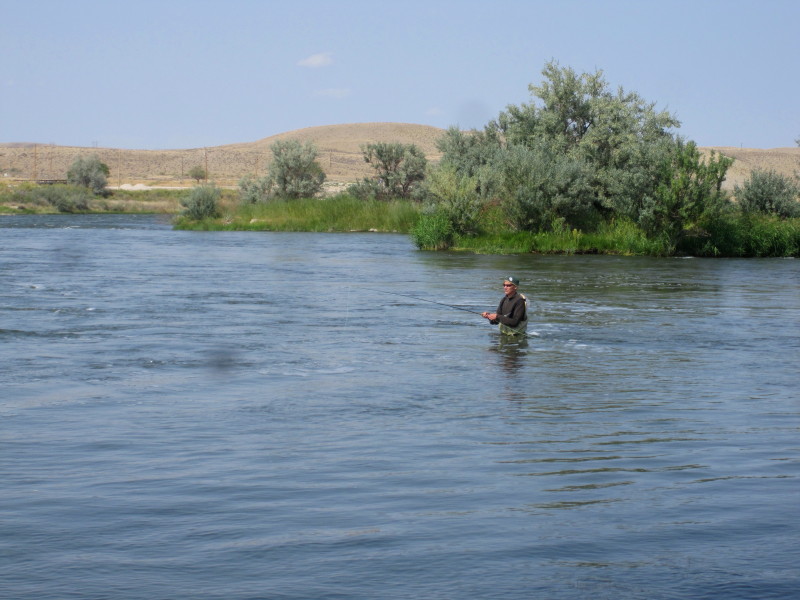
I fished the North Platte river for two days as a last hurrah to summer fishing.  Jeff and I drove up Thursday morning abandoning all manner of important business that could not wait til Monday.  The water was running high out of the Gray Reef dam at 2600 cfs.  At this level wading is a challenge and many people seem to just stay away - which is fine with me,  In my experience, the fishing can be very good when the water is running this high.  

Jeff wading deep below the Gray Reef dam.
I rigged up the Sage 5 weight 11 foot switch rod with a standard two fly nymph rig with a large white thingamabobber strike indicator.  The long rod is pure pleasure on big water like the reef.  I hardly ever bother with a two handed cast there but, when you've waded out to within an inch of the tops of your waders, that extra length means a lot.  The rod is light enough to cast single handed all day and the extra length makes mending a breeze.

We hooked up and caught fish throughout the day.  My largest was about twenty inches, shown in my net in the photo at the top.  That fish, and many others, took a Mercury midge tied on a size 20 Dai-Riki #135 scud/pupa hook with a body of slightly off-white/cream thread instead of the standard white. I should give an update on the pattern I'm using now which is a bit different from the one in the previous post. This has been my go-to fly when midges are on the menu which is almost always.  Jeff had good luck with the fish taking a silver bead headed Zebra Midge tied on the same hook. 

Around five we ate what passes for food at the sadly unbearable Sunset Grill in Alcova. I've sworn this place off more than once and I end up there again and again, it's the only place to eat in Alcova.  The Sunset reeks of stale cigarette smoke which is embedded in the very structure of the place. The food is almost as unbearable as the air. Having previously eaten hamburgers there, I ordered the fish and chips. The freezer burned fish tasted no better than fried breaded cardboard.  In contrast to the Sunset Grill, we stayed in the newer cabins rented out of Sloane's General Store. Can't miss it, it's the only place to buy gas in Alcova. For some reason, they call the cabins The Inn at Alcova but they are commonly known as Sloane's cabins. They are clean, they have fully equipped kitchens and gas grills and run $90 per night for two.  If we'd known we were going to stay there we'd have brought our own food to cook for ourselves.
Bead head caddis pupa pattern proved very effective both days.
After we choked down our dinner we geared up to fish again below the dam until after dark.  Just about the the sun went down, caddis started coming off the water and, in the failing light,  I managed to tie on a bead head caddis pupae.  I started hooking up right away and landed eight fish before I started to get too nervous about wading in the dark through the deep trough that was between me and the shore.  A headlamp would have been an excellent idea.

We met up with John in the parking lot who had driven up from Laramie with his drift boat.  We made plans to meet in the morning to float the river which I've only rarely done before.

Thursday, 9 August 2012

Beginings: guns and shooting


My taste in rifles and shotguns was largely formed from reading Stephen Bodio's book Good Guns Again: A Celebration of Fine Sporting Arms. Surprisingly, it is currently not in print (Steve we need an updated edition) though used copies are available.   I did not grow up in a family of hunters and we never had a gun in the house when I was growing up so I learned most of what I know from books.

*          *          *

My grandfather in Louisiana had a side-by-side shotgun for shooting quail, armadillos and stray cats. He also had owned a Smith and Wesson revolver for protection.  When we would visit, the guns were stashed away, still in view, but up on a high shelf. My grandfather was not a particularly friendly man but he did once let me shoot his revolver, I don't know what caliber it was. I must have been about five or six. We went out behind the house where there was a huge pecan tree stump. He propped up a Coke bottle at the base of the stump.  I was supposed to shoot at the bottle from about 10 feet away. I could barely hold the heavy revolver so he stood behind me and helped me hold it. Pulling the trigger was no easy matter and in the process of doing so I lifted and when the gun went off, surprising the hell out of me, the shot passed over the top of the stump, across the fence and into the pecan grove behind.  Some of Lucille Watson's cattle were out in shaded pasture below the trees.  My grandfather grabbed the revolver from my hand and spewed profanities and then told me what would happen to him (and me) if I'd shot one of Lucille's steers.  That was the end of my training in the use of firearms until I went off to boy scout camp.


*          *          *


This business of taste in firearms is rather subtle and turns on some mighty fine points that are only learned by spending a lot of time looking at and handling a lot of old guns and rifles.  There used to be some excellent gun stores where large selections of used firearms were out on the racks for customers to handle. Among others I'm thinking of Green Top in Richmond VA and Creekside Gun Shop in Bloomfield NY. Creekside is gone now but the son of the owner is Doug Turnbull does some amazing restoration work. Today, most Cabela's stores have fine gun rooms and there is a similar gun room in the Denver Bass Pro Shop too. These places tend to function more as mini-museums with families of gawkers scurrying around trying to find the highest price tags but not paying much attention to the actual firearms they are attached to.  I don't have much patience for these mega-stores or the knock-off goods they sell but they do offer the serious student of fine firearms a chance to study them up close.  The staff can usually recognize a serious aficionado and will allow you to handle the guns you might be interested.  Don't bother to ask to handle the $100,000 items in glass cases - at least I don't.

1903 Mannlicher Schoenauer chambered for the 6.5x54 MS cartridge.
Of course, the internet is an amazing resource and a snapshot of the sites like Gun Broker, Guns International and Guns America will essentially show you everything that is available worldwide at that time. Looking at those internet sites it may seem like there is an unlimited supply of fine old firearms.  That illusion disappears once you start to look for something particular, say a 1903 Mannlicher Schoenauer in 6.5x54 with an elegant peep sight integrated into the top tang.   In the larger scheme of things, there were only a relatively small number of fine firearms ever made and each one is unique in its own way. If they didn't start that way, they become so through the passage of ownership with dings, nicks and scratches, pluming of blue and deepening of patina, and from updates and repairs and the general passing of time.