Monday, 14 March 2011

Gray day @ Gray Reef

10/29/11: I've been remiss in keeping the blog up -- I plan to spend a little time bringing up to date. Following the convention I've previously used, the posting dates will coincide with the events they document.  This posting was never published.


Fishing at Gray Reef last spring.


Gray bearded man on a gray March day at Gray Reef.
Spent the day fishing at gray reef.  There was hardly anyone else there and I caught a a bunch of small fish.  I've never caught small ones in this water.  Also, I have fished here for years and never have seen crayfish.   The bottom was covered with molted crayfish exoskeletons.


I'd never really thought of trying a crayfish pattern at the Reef but based on these observations, I decided I'd better tie some up.

Friday, 4 March 2011

On the Wind River

"Catching fish is undeniably a pleasure, and I'd rather do it than not, but there is a pleasure too in fishing, the savor of pure possibility always on the brink of realizing itself - or not - and the attraction of fishing has much to do with the keenness of  expectation and desire urged against the uncertain and the unpredictable."   
                                     Ted Leeson, The Habit of Rivers, Lyons and Buford, 1994


Two large rainbows.

Driving to Cody for the weekend we got to the Wind River at Boysen State Park about an hour before the sun dropped behind the canyon walls. This was not really a fishing trip but I'd carried my gear. After getting suited up for winter fishing and rigging my rod and tying on some small midge patterns I only had about a half hour left before the sun fell behind the canyon rim. Once the sun was gone I was blind as far as sight fishing was concerned.


These two fish would move out of the main current into a back eddy. In the photo above they are facing downriver, heads into a small upstream eddy. This kind of lie often presents one of the trickiest situations for getting a good drag-free drift. I was optimistic that I'd hook-up, but my optimism was unwarranted.

Wind River just below Boysen Reservoir
The east slope of the Wind River mountains is the source of the eponymous river.  After flowing east it turns north at the Boysen reservoir. Downstream from Boysen the Wind River flows onto the Wind River reservation dropping into a deep canyon which is about 12 miles long.  The river becomes the Big Horn at the Wedding of the Waters, just past the end of the canyon. It  flows north through Thermopolis WY and into Montana merging with the Yellowstone and eventually the Missouri.  The canyon part of the river is known for seriously large brown trout.  As I understand it, one guide has the rights from the tribe to float the canyon and charges a premium.  I'm told it's worth it. You need a permit from the tribe to fish on reservation waters. The canyon is famous for its rattlesnakes.

*                       *                       *

On Sunday we stopped again at Boysen on our way back south.  The weather was not nearly as pleasant; it was snowing and heavily overcast so sight fishing was out of the question.  Overcast weather is by no means bad fisherman's weather; most anglers would claim the opposite, but a snowy March day in Wyoming can be biting cold.  I fished for a bit more than an hour while P read in the truck and though I never got cold I never caught a fish either. I briefly spoke to a young local hotshot (who wasn't catching anything either) and he told me to tie on a pink sow bug, or a Ray Charles midge.  I didn't know the Ray Charles pattern  but looked it up when I got home; it's another sow bug pattern. I did tie on a pink sow bug, I always carry a few in my nymph box.
Sow bug soft hackle: tied and photographed by the author.
A sow bug is an aquatic crustacean, an Isopod. The pink sow-bug soft hackle pattern is popular on the Big Horn tailwater below Yellowtail dam. That's 100 miles or so north (downriver) of where I was fishing. I find it interesting because I've never seen that pink sow bug pattern used anywhere except on the Big Horn and it really does work magic there.   I have to wonder if there is an entomological basis for using the pattern on the Wind River or if its use there is a cultural artifact, having migrated upstream. 


*                       *                       *
I've admired the beautiful section of river below Boysen Reservoir before but had never fished it.  Although I didn't hook up I learned quite a bit about the river there. There is a large body of common fishing knowledge but river knowledge is local knowledge. It takes time to learn about the habits of a river and each river has its own particular habits.

Saturday, 26 February 2011

Lyman Peep -- Dummy Slide


Up until the point where telescopic sights (scopes) became reliable enough, metalic sights were the standard.  Among metalic sights, the aperture or peep sights provided the best accuracy.   The Lyman company first started manufacturing aperture sights in the 1880's. For lever action rifles, they were typically mounted to the stock behind the action.   After WWI,  bolt action rifles started being used widely for hunting and for these rifles, peep sights were mounted on the receiver itself.  There are a number of advantages to a peep sight.  Since they are mounted so far from the front sight, they are inherently more accurate -- this is a matter of geometry.


Consider a line with points marked A, B and C where the distance AC is twice the distance AB. Now mark points B' and C' by measuring distance x perpendicular to line AC at points B and C. Now, if the angle C'AC is θ, the angle B'AB is twice as much, it is 2θ.  An equal displacement at the greater distance has a smaller effect allowing for finer sight control.

The other advantage of the peep sight over open metallic sights is that the human eye naturally centers the front sight in the center of the circular opening of the aperture.  This makes for quickness and accuracy in the aiming process.  The physiological effect is so strikingly effective that Elmer Keith recommended unscrewing and discarding the small target aperture as soon as the sight is mounted.  The open hole the target aperture screws into is larger and so quicker to sight with.


I have a Lyman 48 peep on my elk rifle.  If the snow is blowing I can remove the scope and attach the peep slide or, to use the scope, I can remove the peep and attach the scope.  The drawback is that when the scope is attached, the open slide is ugly and it leaves the small indicator liable to damage.

To resolve this issue, I decided to make a dummy slide to fill the gap when the peep is not installed.  I filed some mild steel into the required dovetail shape.


After  sanding it smooth and cutting it to length and I blued it using Brownell's Oxpho-Blue cold bluing liquid.


The finished slide fits snugly and gives the rifle a finished look when the scope is mounted.


The scope mount is a Griffin & Howe side mount which allows the scope to be easily removed and when remounted, it goes back to zero.

Friday, 4 February 2011

On good bread and good guns.

     It does not cost much. It is pleasant: one of the most hypnotic businesses, like a dance from some ancient ceremony. It leaves you filled with peace, and the house filled with one of the world's sweetest smells. But it takes a lot of time. If you can find that, the rest is easy. And if you can not rightly find it, make it, for probably there is no chiropractic treatment, no Yoga exercise, no hour of meditation in a music-throbbing chapel, that will leave you emptier of bad thoughts than this homely exercise of making bread.
                                        M.F.K. Fisher, How to Cook a Wolf. 1942


Making bread is a great thing. The only drawback M.F.K. Fisher could find was that it takes a lot of time. The no-knead bread recipes essentially eliminate the time element so there really is no reason not to make bread anymore.  Here's a photo of the loaf from yesterday.  I sometimes make it, but P is getting really good at this.

                                  *            *             *      

Datus Proper first brought my attention to M.F.K. Fisher's writing in his own book Pheasant's of the Mind: A Hunter's Search for a Mythical Bird.. In that book, he frequently and reverently refers to her translation of Brillat-Savarin's The Physiology of Taste.

 In Proper's pheasant hunting book he puts forth the proposition that a man should own one good shotgun and that a month's salary is not an unreasonable figure to account for it.  A suggestion I found shocking when I read it and somehow still do; a month's salary has never been available to me for such a purchase.  For himself, Proper followed his own advice.  He hunted a side-by-side sidelock shotgun made by  James Woodward.  A London best gun made some time just before the turn of the last century.  A quick search reveals that only Woodward side-by-side I can find listed on the internet right now (it is sold) was priced at $28,500. I'm fairly certain that Mr. Proper, who was a Foreign Service officer in the State Department never made that amount in one month, so I guess his strategy turned out to be a pretty good investment too.

A 12 GA sidelock made by James Woodward & Sons.
In his book Good Guns Again, Stephen Bodio makes a good argument for boxlock actioned shotguns, preferably British made.   Bodio himself also seem to like the rather odd French made Darne slide-action guns.  Boxlock actions have fewer parts and are less delicate than sidelock actions.  Fewer parts means they are generally more reliable, but also fewer parts means they require less precise hand fitting and so are less expensive to make.

Barrel markings on my 12 ga. Jeffery boxlock.
 Unable to follow Proper's advice, I followed Bodio's.  I spent far less than a month's salary on a good, if not best, shotgun.  My own shotgun is a British boxlock made by W. J. Jeffery & Co.  It is labeled with the 13 King Street, St. James's St. London address on the barrels; records indicate it was made in Birmingham in 1906 by a Mr. Clarke.  This was not an uncommon arrangement, to have boxlocks made in Birmingham and sold by London makers. In 2006 I had a little 100 year birthday party for my shotgun.  It has a splinter forend, a straighthand stock, double triggers, 28" barrels and is chambered for the non-standard (in the US anyway) 2 1/2" 12 gauge shells.  The 2 1/2" shell was British standard in the beginning of the last century.


Standard 12 gauge shells are 2 3/4". The fact that it is chambered for non-standard shells meant the price was a bit lower than it might have been.  A standard upland field load for a 2 3/4" shell is 1 1/8 oz. of shot.  The standard load for a 2 1/2" shell is 1 oz. of shot which also happens to be the standard load for a 2 3/4" 16 gauge shells.  A shotgun chambered for the British 2 1/2" 12 gauge shell is quite comparable to a 16 gauge shotgun.  The difference is that a 1oz. load from a 12 gauge barrel packs a bit more of a punch.  The ballistic advantage comes from the fact that the shot itself leaves the larger diameter barrel in a shorter shot column, it is not quite a strung out as it is leaving the smaller diameter 16 gauge barrel.

The action and top lever shows some case coloring, and probably has been refinished.
The British were never really fans of the 16 gauge and not many were made there. It was a favorite on the continent, there were plenty of French and Belgian 16 gauge shotguns made.  In fact, my first side-by-side was a French made 16 gauge; a Breuil with horribly pitted barrels and chambered for another oddball sized shell -- 65mm 16 gauge.  The stock cracked while stored in my gun safe in a damp attic in Ithaca NY. That gun was never the same. Sixtten gauge shotguns were  was popular here in the US too.  Many of the classic American shotguns made by  Parker, Fox, L. C. Smith and Ithaca were chambered for 16 gauge shells.
Scroll engraving with Rosettes on the screws.
Engraving was standard practice for fine firearms (even boxlocks) at the turn of the last century.  The Jeffery is engraved with a very elegant fine scroll and and leaf pattern with rosettes on the screws. Modern pressed "engraving" can not compare and as far as I'm concerned, you might as well not have it at all.


                                 *            *             *     
 A few years ago, running up a steep hillside to get into position for a shot at a grouse Erdős was pointing, I slipped on a snow covered log. My arms went out, the Jeffery was in my right hand, and I hit it damn hard on the log.  It put a pretty good gash in the otherwise delicate forend and I was surprised it did not break it.  I would not be surprised if that fall was responsible for the scratch in the engraving (it is just visible if you enlarge the image above.) Since then I have been a bit more careful about the kind of hunting I do with it.  That was about the time I  personalized my 20 gauge Citori so that I had a more pedestrian gun for rough conditions like Chukar hunting.  To me, it is unacceptable to put the Jeffery away in the safe and not use it, it is a fine tool perfectly designed and expertly built for its intended use.  But there is a balance between using it an caring for it, I don't so much own my 105 year old shotgun, it's more that I'm the current caretaker.

A really good loaf - open crumb, large hole structure, crispy crust, great flavor.


So how does one get from bread to guns and back again?  These are the well trod paths of my autodidact mind.

Sunday, 2 January 2011

Commonplace books
and a quote from Huish Edye

In recent blog postings Stephen Bodio has labeled a number of entries Commonplace Book.  Bodio tells us that in England, a commonplace book is an journal in which one records quotes of interest.

Reading Bodio's blog had me thinking of a longtime favorite quote of mine.  It comes from Huish Edye's (only) book The Angler and the Trout. The book was  published in 1941 by the great British publishing house A.& C. Black,  they published a rather large collection of important fishing titles including G. E. M. Skues early work on nymph fishing.  In his own book, describing the intensity of his fishing interests, Edye writes:
I would rather kill a brace of fish weighing three pounds in a day on the Otter (my favourite stream) than a brace of warrantable tigers in a day among the Himalayan foothills.  The former ambition I have not yet achieved; the latter I have achieved more than once.
A rather amazing statement.  The idea of killing a brace of tigers in the Himalayan foothills in the 1920's or 30's sounds, to me anyway, far more interesting sport than killing a brace of trout, of any size anywhere.  But that is his point, isn't it?  To an angler, the sport of catching trout that are exceptionally large for the stream is as challenging (or more so) than hunting dangerous game in India. The language itself is compelling. There is a certain tortured formal structure to these sentences that I love. Much of the book reads this way.

From what I can discover about Edye (there is surprisingly little information about him online) Ernest Henry Huish Edye was born at Leigham Manor, Plympton, Devonshire in 1884.  He served as a District Officer in the Indian Civil Service under British rule from 1908 until 1938 .  He is listed as Superintendent of Census Operations for the census of India, United Provinces of Agra and Oudh in 1921. Under the pseudonym Distoffer, he frequently wrote for the British sporting magazines The Field and Game and Gun: A Bi-monthly Journal of Home and Overseas Field Sport.  It seems obvious to me now that "Distoffer" is an a contraction of an abbreviation of District Officer, his title in the Civil Service.  Unfortunately, I can not find online access to indexes for The Field or Game and Gun.

I first ran across Edye's writing in Leonard Wright's collection A Flyfishing Reader  (Simon and Schuster,1990.)  The article included there, entitled The Mannerisms of Big Trout,  is a chapter excerpted from Edye's book.  In that chapter, he starts by developing a classification of trout based on their size relative to the size of an average mature fish in that water; a rather environmental  point of view.   He classifies a trout as good if it is "considerably bigger than a merely adult trout" (for that water) and a master fish as a "very exceptionally heavy trout."  He then discusses the mannerisms of master fish, whatever river they may live in. The premise being that, while the size of the master fish  may vary significantly from river to river, their behavior does not.  This idea levels the playing field, a master fish is a master fish and the absolute size of a fish has little to do with the skill required to catch it.  A three pound trout on the Laramie is master fish, a three pound trout at Gray Reef on the North Platte is rather ordinary.

The quoted passage occurs on page eight of Edye's book and falls squarely in the tradition of introducing  fishing as a more interesting sporting pastime than any other, this  before diving in to the main body of the work.  This tradition in the fishing literature  goes back to the earliest known books.  Both A Treatyse of Fysshynge wyth an Angle, by Juliana Berners and Izaak Walton's The Compleat Angler start by considering other sports and explaining why they are inferior to angling.  The former book was first printed in 1486, the latter in 1653. 

The idea that Edye offers up, that catching a master trout (even on not particularly famous water)  is better sport than the exotic and decidedly more dangerous game of tiger hunting is a kind of a hook.  We had better sit up and pay attention when such a claim is made by an experienced and thoughtful man.

My own interest in fly fishing was sparked from a similar quarter.  Years before I took up fishing, I was on a climbing trip with friends in the Bugaboo Range in British Columbia.   Two rather scrubby and extraordinarily accomplished climbers came into the hut while we were there.  Before arriving in the Bugs they had most recently completed a rather desperate climb of the Emperor Ridge on Mount Robsen and before that had been climbing in Alaska.  In the evening, after they'd dashed up the Becky/Chouinard route on South Howser Tower in record time, we sat and talked.  One of them talked about the fishing they'd done in Alaska for rainbow trout.  I scoffed. At that the climber sat forward and looked me square in the eye and rather intensely said "Ah, but you don't understand."  And, of course I didn't.  But that remark from a clearly remarkable person has stayed with me to this day and was the genesis of my adult interest in fishing.

Friday, 31 December 2010

Elk season.

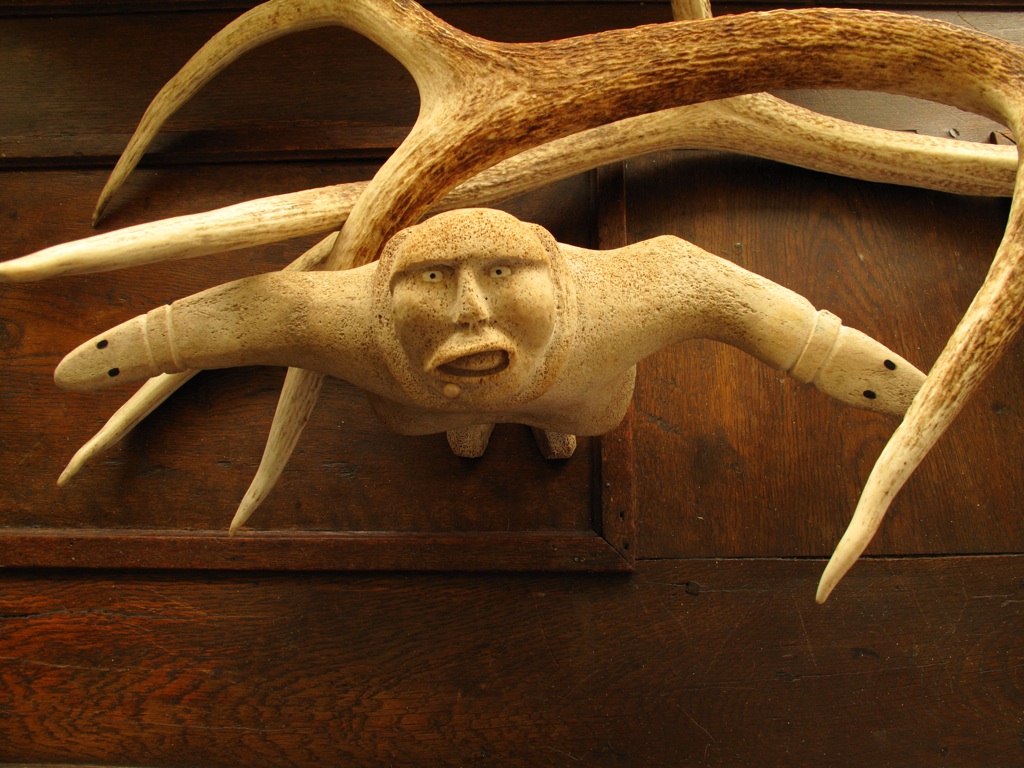
Inuit whalebone carving of shaman.
The big game hunting seasons last but a short time.  Two weeks for deer and two weeks for elk, antelope season is almost a month.  Surely it is best to be immersed in the hunt, to stay connected to the rhythms of the sunrise and sunset and the weather and to open oneself to the intuition which seems to be crucial to success. This year my hunt was even more disjointed than usual. Many obligations fell in the middle of the short elk hunting season.  Aside from the normal work duties, hunting season falls near the middle of the fall semester, we were finishing building a new house and then, we moved in on October 15th, the first day of elk season. The following weekend was largely taken up with finishing the move.  I was only able to get out two afternoons during the two week long general elk season in the local area.  Neither day did I kill an elk.

On the first afternoon out I hunted an area where I could shoot a bull or a cow. It meant driving further from home but bull elk are by far in the minority and having failed to kill a deer, I was after meat. After a long drive down a very bad dirt road, trying to get to the edge of the Platte River wilderness area, I was blocked by recently fallen trees.   With the pine bark beetles killing the forest I carry a chainsaw in the truck in case a tree comes down behind me blocking my exit.  I did not take the time to clear this one and hunted into the wilderness from where I was halted.  I found plenty of mule deer and elk sign, including sign of a recent mountain lion kill.  I was back to the truck by headlamp after dark, not having seen an animal.

The Southwestern Naturalist 48(1):147-153. 2003
On my second afternoon out, the last day of the local season, I headed back to the same area.  I'd seen enough elk sign the day before that I was not completely pessimistic about my chances for an animal.  As I drove up the canyon on Hwy 230 above Woods Landing toward Fox Park, a very panicked and very large bull ran across the road right in front of me. I looked him in the eye as he passed not fifty feet in front of me. I pulled over about a hundred yards up the road as he jumped a fence and ran off into the forest. It was a large bull, as large as I've seen during hunting season with a rifle at hand. He was dark and carried a six-by-six rack with a huge non-standard drop tine low on the right side that arched down in front of his head.  The atypical tine was thicker at the end than where it attached to the main beam, it was as thick as a baseball bat. For a second I had the irrational thought that I needed to quickly drive on to where I was planning to hunt.  For that second I thought that I could not shoot an elk in the area I was in --  I could not shoot a cow there, but a bull was fair game.  I grabbed my rifle, some shells and my blaze orange hat and took off after him leaving the truck unlocked and most of my gear on the back seat.   I followed his tracks for some distance, stopping to look and listen and then moved off his track following the lay of the land hoping to cut him off further up the draw he was following.   I hunted for a two hours, almost until dusk, and finally I made my way back to the truck to get water and my binoculars.  Rather than hunt back up from the same side of the ridge he'd disappeared over,  I drove around the back of the ridge on some desperately bad roads and hunted him from that side until after dark.  No luck.

I have driven up Hwy 230 more than a hundred times and have never seen an elk on the road there; as I went after him I could not  help but think that he was mine, a kind of a gift. Leaving my binoculars and other gear in the truck was a big mistake.   Elk tend to run until they feel they are safe, which is often not too far, and then will hide in thick cover.  I had little chance of spotting him before he spotted me through the dense lodgepoles without my binoculars.  I believe I would have killed him if I'd have had them. Another lesson learned.

*        *         *  

After that hunt I thought my season was over.  I studied the regulations and discovered that within a two hour drive there were two areas where cow elk (but not bulls) could be tagged until November 14th on a general elk license. The open areas were above Encampment WY on the north side of the Battle Mountain highway and over the continental divide toward Baggs WY. I was not able to get away until the second weekend in November, the last weekend.

Above Encampment there was lots of of snow, I was a bit worried about the forest service road but it was passable, with 4-wheel drive and good tires.  Right at the turn-in  I cut some fresh tracks and I geared up and started to follow them.   It was 7:20 AM.  Before long I was following an animal that was bleeding -- intermittently but heavily at times. It had bedded down more than once and there were pools of blood at the beds, though as I followed, there seemed to be less blood. The animal had large tracks so I was worried that it was a bull (which I could not shoot), or even a moose.  After less than a mile I jumped her. I  could not tell for sure if it was a cow or bull because I only saw the butt before she crashed off into thick timber.  I did not get a shot.

This happened two more times before she crossed the forest service road.  She would wander into an old overgrown clearcut and bed down, even thought I was never far behind.  There was no way for me to be quiet on my approach in those dense places and she'd hear me and crash off before I could even see her.   I followed her tracks to the road and there was truck idling there, she'd crossed, dropping some blood, and some guy had stopped and was following her on the other side of the road -- just to see what was up. He was cutting firewood having killed a cow the night before.  He drove me back to my truck so I could move it down the road (maybe 3/4 mile) before following her again.

I moved the truck down to the new crossing point and took off after her again.  I bumped her out of thick cover again almost right away and did so too more times in the next mile an a half.  At one point, in the heavy cover of an old clearcut, she was very close and she grunted threateningly at me before crashing off.  She did it again about a quarter of a mile further along and I ran forward and as she ran off I took a hail Mary shot through the thick trees.  I knew she was already wounded in some way and I was getting worried about how I was going to get her out since now I was far from the truck. I was shooting 250 grain round-nose bullets out of the 35 Whelen at around 2500 fps; a brush bucker if there is one.  I had followed her more than a mile from the truck, closer to two,  and I did not have my GPS so, aside from the fact that I knew the road was somewhere southwest of me, the only true way I knew to get back to my truck was to follow my tracks.  It was snowing so I was worried my tracks would disappear. At the first shot she stopped, then started wobbling forward -- I ran forward and I could see her clearly this time -- and at the second shot she went down. I hit her in the heart.   It was 10:15 AM, just about three hours after I'd started tracking her.  The blood I'd been seeing was from her left rear leg which was shattered and hanging free just below the hock joint.  I have no idea how she kept in front of me for three miles, maybe four, we'd made wide detours from the road.

Cow elk: I tracked her for about 4 miles.
When she did go down, I was definitely worried about how far from the road I was -- but also, she'd fallen on just next to an old logging road so I thought there might be a way out to the main road.   And then I heard a truck, and although road sounds can be terribly deceiving -- I thought that the road was not far. About twenty minutes later two hunters came walking in on me.  I asked how far it was to the road.
They said "About eighty-five yards, just follow our tracks."
This was luck beyond belief. I gralloched her and hiked back out to get my truck and my dog.  I pulled in my orange toboggan in and carried the game bags.  It took two trips to get her out.  By 3:30 I was on my way home.  I stopped in Encampment, an otherwise deserted town, at the surprisingly stylish Chez Booze and picked up a bottle of Jameson.

I took a chance by following up a wounded animal.  There was no telling if she'd been gut shot or how much meat might have been ruined.  Nichola Fletcher warns that the meat from a stressed animal may be inedible and certainly will not be as good as the meat from an animal that has been dispatched quickly.  But I did feel good about taking an animal that would not have survived the winter.  The meat was hung for a week before I butchered it.  For a change, I had near perfect temperatures, freezing at night and up into the low 40's during the day.  It has proved to be excellent.

Sunday, 14 November 2010