Showing posts with label Elk. Show all posts

Tuesday, 13 November 2012

Elk Season: The Conclusion

Fresh snow, rifle, and pack.

As I mentioned I was going to do in a previous post  - I picked up a leftover cow/calf tag and continued hunting this past weekend on the northeast side of the Snowy Range. I hunted with an unnamed friend on Saturday who I'll call The Pirate and on Sunday we were joined by  Mr. Stone.

*                             *                             *
 
Saturday, 10 November 2012: Overnight we'd had two to four inches of fresh snow and temperatures we predicted to drop all day going down into the single digits by nightfall.  As we got on I-80 West out of Laramie the warning sign blinked the message "NO LIGHT TRAILERS - WIND GUSTS 60 MPH+".  This was perfect.

There is no shortage of theories among elk hunters; some of them hold up to scrutiny bearing some relationship to reality and others are just  pipe dreams or wishful thinking. Theories abound as to whether the elk are up high or down low, and if so, why? One theory says that fresh snow, high wind and a significant cold front coming through will tend to push the elk down to lower elevation.  This is the one the Pirate and I were counting on.  How else can you put a positive spin on 60 MPH+ winds?  It's good weather for elk hunting,  that's how.

As we parked the truck at the Pirate's cabin he spotted an elk up a steep hillside in the open sage about three quarters of a mile away.  With my binoculars we could make out six elk. I thought to myself:  "This is just going to be too easy.  I'll be home by mid-afternoon."  We grabbed our rifles, threw on our packs, hopped on the 4-wheeler and headed toward the base of the open slope.  Last I saw them, the elk did not seem to mind the noise of the ATV.  We parked in the timber and carefully made our way on foot to the sage opening where we'd seen the elk not fifteen minutes earlier. They were, of course, gone but the tracks in the fresh snow were easy to follow.   We followed the tracks for two and a half miles before giving up near the top of a ridge with the wind blowing hard and snow falling.  The snow was much deeper up high which made walking a significant effort.  The creeks flow west off the slope we were on and we followed the ridge south to drop back down toward the truck in the next drainage over.

It was after 1 PM and by now and we were cold, tired, hungry and thirsty and a bit wet so we started to get sloppy.  In our rush to get to the elk in the early morning we'd failed to pack our lunches or even drinks. This was a lesson I thought I'd learned before - no matter how short you might think a hunt will be - take everything you would carry for a full day.

Because we were tired and thirsty we were anxious to get back down to the cabin - and so we were moving faster than we should have been, stumbling our way down the mountain.  I'd mostly given up glassing the timber ahead and of course, that's when we bumped a small herd of elk.  They saw us just about the time the Pirate saw them.  He hissed "Elk!" and I looked and saw them.  Nervously trying to fingure which way to run.  I quickly set up on my shooting sticks and though it was a far dicier shot than I like to take, I was willing. As the elk started to run I fixed my sights on an opening in the trees where I'd seen the others pass and as the last cow in the herd ran through, I pulled the trigger. I pulled and nothing happened.  My safety was on.  Exhausted and embarrassed I did not mention the safety to the pirate.

Blowing snow and blue skies on the drive out.

We got back to the cabin in a howling wind with temperatures in the teens and even after warming up, neither of us could bring ourselves to head out for a late-afternoon/evening hunt.  We drove back to town in a big blow.  If it was 10°F and the wind was blowing at 50 MPH,  the wind chill was -39°F (old method) or -17°F (new method). In any case it was brutally cold and a minute without gloves on left your hands hurting. This is weather that can cause frostbite, it is weather that can kill you.

*                             *                             *


Sunday, 11 November 2012:  The Pirate's friend Mr. Stone joined us on Sunday. He and the Pirate had been hunting hard all season in the same area where we'd bumped elk the day before but they had never been so lucky.   The plan was that the Pirate and I would hunt together up one drainage and the quiet Mr. Stone would hunt alone up the next one to the south. We planned to meet up in a few hours at the top of the ridge.  It was still damn cold with high winds and it was practically unbearable riding in on the back of 4 Wheeler through the open country trying to get into the trees.

Almost as soon as we got into the timber we cut tracks.  A heard of five or six elk headed uphill.  We followed the tracks on foot.  About a half a mile in, as we neared the top of a steep slope, I just knew they'd be bedded down on the flat in the timber.  The Pirate and I separated a bit, me to the right, and moved up onto the flat.  We quietly stood and looked and listened when we were off the steep. Just like the day before, the Pirate hissed  "Elk!" and I turned toward him and saw them, about 60 yards away through the timber.  After the previous days shooting debacle I quickly got my sights on them, flipped off the safety and, just as they started to run, I pulled the trigger.  I did not see an elk fall and I felt I must have missed - for the second time this season.  I quickly headed toward the spot where they'd been.  There was no blood. I was sure I'd aimed high.

We tracked those elk for more than a mile before we gave up. We circled around and headed back to the 4 Wheeler and to the cabin for lunch.  Mr. Stone had also followed elk and jumped one off her bed but had not had a shot.

Cow elk down last Sunday - just at dusk.
For the afternoon hunt we drove up as high as we could get through the snow on the 4 Wheelers and hunted from there. The winds were still high, my legs were tired and I'd lost hope.  I really just wanted to call it a day.  The three of us split up and hunted uphill meeting on a rocky high point absurd winds ravaging the landscape. As I stood there I heard the honking of a flock of geese and I saw them for a moment through the blowing snow before they were blown away into the haze.  None of us had seen fresh tracks. As we hunted back down the Pirate and I dropped off a steep slope into dense timber and Mr. Stone hunted the contour.

Off that rim and down in the thick timber it suddenly got very quiet and there were elk tracks everywhere. There must have been 20 elk and possibly more in the herd we'd dropped into.  We hunted slowly downhill, separated by 50 feet or so, slowly and silently weaving our way through the trees, expecting to see them at any second.  Further and further down we went until we were well below the 4 Wheelers.  It was close to 3:30 PM and after a short consult,  we decided to hunt just a bit further.  And of course, that is when we saw them.  Determined not to repeat my earlier errors I clicked off the safety and took aim but did not shoot because the shot was not clear. And then they saw the Pirate who was below me  and the forest exploded with elk running in every direction.  A panicked cow tore up the steep gully, not more than 15 yards in front of me, I swung my rifle like a shotgun and pulled the trigger and she ran by.  She fell instantly onto a log sticking out of the side of the narrow ravine.  She wasn't going anywhere but I put a second bullet into her heart to finish her.  The first shot that had dropped her was a neck shot.

I gutted my elk and left her where she lay and walked out to the 4 Wheelers in the dark. From the cabin  we drove out to I-80 in a serious whiteout which forced us to stop frequently to wait for the wind to die down.

*                             *                             *

Monday: 12 November 2012

Up at 5 AM again.  During a long elk season a work day, when I can sleep in until at least 6 AM, is almost a welcome reprieve.  This day I had a PhD prelim to attend.  It had been scheduled for months and I could not miss it.  The wind had died down and up on the mountain we were able to get the 4 Wheeler to the edge of the ravine where my elk had fallen.  We were able to use the winch to pull her up and out of the ravine and then were able to drag her all they way to my truck. We managed to load her whole into the back of my Toyota. 

Whole elk in the back of my truck.
Thanks to the Pirate and Mr. Stone for their help.

Friday, 31 December 2010

Elk season.

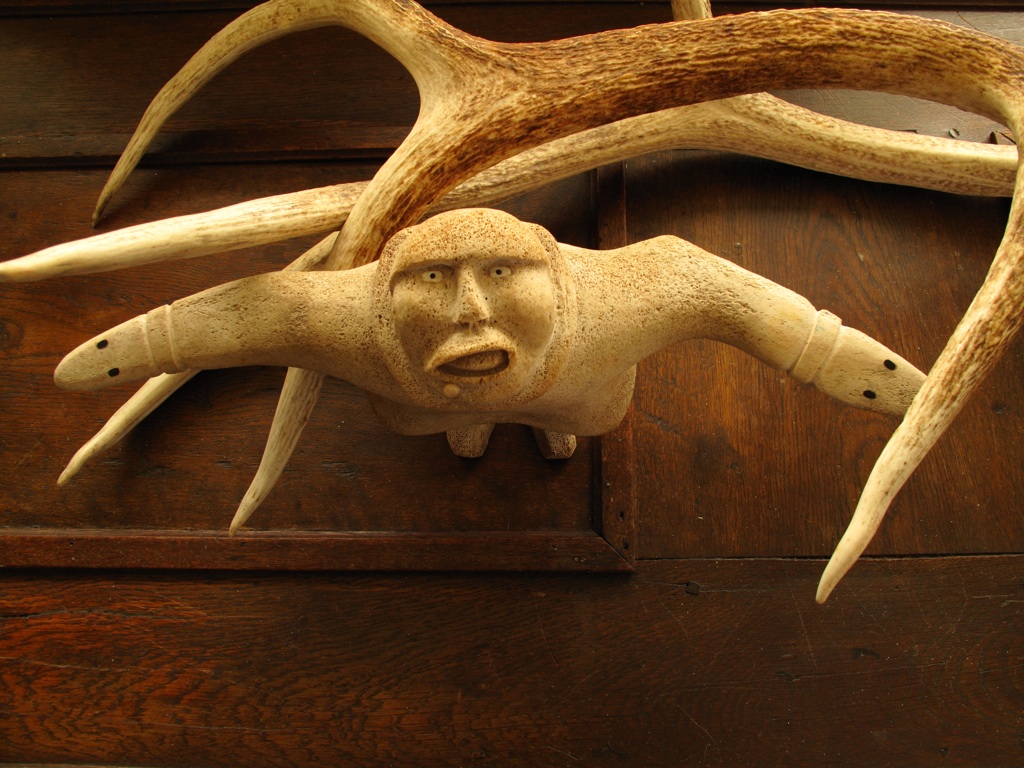
Inuit whalebone carving of shaman.
The big game hunting seasons last but a short time.  Two weeks for deer and two weeks for elk, antelope season is almost a month.  Surely it is best to be immersed in the hunt, to stay connected to the rhythms of the sunrise and sunset and the weather and to open oneself to the intuition which seems to be crucial to success. This year my hunt was even more disjointed than usual. Many obligations fell in the middle of the short elk hunting season.  Aside from the normal work duties, hunting season falls near the middle of the fall semester, we were finishing building a new house and then, we moved in on October 15th, the first day of elk season. The following weekend was largely taken up with finishing the move.  I was only able to get out two afternoons during the two week long general elk season in the local area.  Neither day did I kill an elk.

On the first afternoon out I hunted an area where I could shoot a bull or a cow. It meant driving further from home but bull elk are by far in the minority and having failed to kill a deer, I was after meat. After a long drive down a very bad dirt road, trying to get to the edge of the Platte River wilderness area, I was blocked by recently fallen trees.   With the pine bark beetles killing the forest I carry a chainsaw in the truck in case a tree comes down behind me blocking my exit.  I did not take the time to clear this one and hunted into the wilderness from where I was halted.  I found plenty of mule deer and elk sign, including sign of a recent mountain lion kill.  I was back to the truck by headlamp after dark, not having seen an animal.

The Southwestern Naturalist 48(1):147-153. 2003
On my second afternoon out, the last day of the local season, I headed back to the same area.  I'd seen enough elk sign the day before that I was not completely pessimistic about my chances for an animal.  As I drove up the canyon on Hwy 230 above Woods Landing toward Fox Park, a very panicked and very large bull ran across the road right in front of me. I looked him in the eye as he passed not fifty feet in front of me. I pulled over about a hundred yards up the road as he jumped a fence and ran off into the forest. It was a large bull, as large as I've seen during hunting season with a rifle at hand. He was dark and carried a six-by-six rack with a huge non-standard drop tine low on the right side that arched down in front of his head.  The atypical tine was thicker at the end than where it attached to the main beam, it was as thick as a baseball bat. For a second I had the irrational thought that I needed to quickly drive on to where I was planning to hunt.  For that second I thought that I could not shoot an elk in the area I was in --  I could not shoot a cow there, but a bull was fair game.  I grabbed my rifle, some shells and my blaze orange hat and took off after him leaving the truck unlocked and most of my gear on the back seat.   I followed his tracks for some distance, stopping to look and listen and then moved off his track following the lay of the land hoping to cut him off further up the draw he was following.   I hunted for a two hours, almost until dusk, and finally I made my way back to the truck to get water and my binoculars.  Rather than hunt back up from the same side of the ridge he'd disappeared over,  I drove around the back of the ridge on some desperately bad roads and hunted him from that side until after dark.  No luck.

I have driven up Hwy 230 more than a hundred times and have never seen an elk on the road there; as I went after him I could not  help but think that he was mine, a kind of a gift. Leaving my binoculars and other gear in the truck was a big mistake.   Elk tend to run until they feel they are safe, which is often not too far, and then will hide in thick cover.  I had little chance of spotting him before he spotted me through the dense lodgepoles without my binoculars.  I believe I would have killed him if I'd have had them. Another lesson learned.

*        *         *  

After that hunt I thought my season was over.  I studied the regulations and discovered that within a two hour drive there were two areas where cow elk (but not bulls) could be tagged until November 14th on a general elk license. The open areas were above Encampment WY on the north side of the Battle Mountain highway and over the continental divide toward Baggs WY. I was not able to get away until the second weekend in November, the last weekend.

Above Encampment there was lots of of snow, I was a bit worried about the forest service road but it was passable, with 4-wheel drive and good tires.  Right at the turn-in  I cut some fresh tracks and I geared up and started to follow them.   It was 7:20 AM.  Before long I was following an animal that was bleeding -- intermittently but heavily at times. It had bedded down more than once and there were pools of blood at the beds, though as I followed, there seemed to be less blood. The animal had large tracks so I was worried that it was a bull (which I could not shoot), or even a moose.  After less than a mile I jumped her. I  could not tell for sure if it was a cow or bull because I only saw the butt before she crashed off into thick timber.  I did not get a shot.

This happened two more times before she crossed the forest service road.  She would wander into an old overgrown clearcut and bed down, even thought I was never far behind.  There was no way for me to be quiet on my approach in those dense places and she'd hear me and crash off before I could even see her.   I followed her tracks to the road and there was truck idling there, she'd crossed, dropping some blood, and some guy had stopped and was following her on the other side of the road -- just to see what was up. He was cutting firewood having killed a cow the night before.  He drove me back to my truck so I could move it down the road (maybe 3/4 mile) before following her again.

I moved the truck down to the new crossing point and took off after her again.  I bumped her out of thick cover again almost right away and did so too more times in the next mile an a half.  At one point, in the heavy cover of an old clearcut, she was very close and she grunted threateningly at me before crashing off.  She did it again about a quarter of a mile further along and I ran forward and as she ran off I took a hail Mary shot through the thick trees.  I knew she was already wounded in some way and I was getting worried about how I was going to get her out since now I was far from the truck. I was shooting 250 grain round-nose bullets out of the 35 Whelen at around 2500 fps; a brush bucker if there is one.  I had followed her more than a mile from the truck, closer to two,  and I did not have my GPS so, aside from the fact that I knew the road was somewhere southwest of me, the only true way I knew to get back to my truck was to follow my tracks.  It was snowing so I was worried my tracks would disappear. At the first shot she stopped, then started wobbling forward -- I ran forward and I could see her clearly this time -- and at the second shot she went down. I hit her in the heart.   It was 10:15 AM, just about three hours after I'd started tracking her.  The blood I'd been seeing was from her left rear leg which was shattered and hanging free just below the hock joint.  I have no idea how she kept in front of me for three miles, maybe four, we'd made wide detours from the road.

Cow elk: I tracked her for about 4 miles.
When she did go down, I was definitely worried about how far from the road I was -- but also, she'd fallen on just next to an old logging road so I thought there might be a way out to the main road.   And then I heard a truck, and although road sounds can be terribly deceiving -- I thought that the road was not far. About twenty minutes later two hunters came walking in on me.  I asked how far it was to the road.
They said "About eighty-five yards, just follow our tracks."
This was luck beyond belief. I gralloched her and hiked back out to get my truck and my dog.  I pulled in my orange toboggan in and carried the game bags.  It took two trips to get her out.  By 3:30 I was on my way home.  I stopped in Encampment, an otherwise deserted town, at the surprisingly stylish Chez Booze and picked up a bottle of Jameson.

I took a chance by following up a wounded animal.  There was no telling if she'd been gut shot or how much meat might have been ruined.  Nichola Fletcher warns that the meat from a stressed animal may be inedible and certainly will not be as good as the meat from an animal that has been dispatched quickly.  But I did feel good about taking an animal that would not have survived the winter.  The meat was hung for a week before I butchered it.  For a change, I had near perfect temperatures, freezing at night and up into the low 40's during the day.  It has proved to be excellent.

Sunday, 14 November 2010

Sunday, 14 February 2010

Game Meat Charcuterie


For a number of reasons I butcher my own game meat. It's hard work and usually takes me two days to butcher and wrap an elk for the freezer, this is after it has been quartered, skinned bagged and hung. I am  a slow butcher.   One benefit  of hiring a butcher is that they will typically offer to make sausages as part of the order.  Until now, I have not done so for myself.

Aside from the sausages, there are a number of downsides to hiring a butcher. For one thing, it's expensive.  Last time I checked, it would have cost me $250 to have an elk butchered that had already been skinned, quartered, bagged and hung (that price did not include sausages.) For another, there's really no telling whose meat you'll get back.  This is an issue because there is CWD in the deer and elk herd here in SE Wyoming.  Even though there is no known risk to humans, I have my animals tested at the Wyoming state vet lab before eating them.  I only want the meat from my own animal.  Also, and perhaps most importantly, the local butchers never have enough space or time during the rush of hunting season to hang the meat as long as is needed.


Here is my recipe, sort of cobbled together from sources on the internet and an article in Saveur No. 31 (December 1998).

2                           Natural Sausage Casings (about 4' long each)
2 1/2 lbs                Elk (ground)
2 1/2 lbs                Pork shoulder (ground)
1/2 lb                    bacon (ground)
paprika                 cover and mix 4 times
fennel seed            cover and mix 3 times
oregano                 cover and mix 3 times
garlic                     10 cloves (finely chopped)
red-pepper flake   sparsely cover and mix 3 times
black pepper         cover and mix 4 times
                             (coarsely cracked with mortar and pestle)
salt                        cover and mix 4 times
cayenne                 lightly dusted and mixed 1 time (optional)

Some things I did not have were fatback which would have been better than bacon  and I would have used hot paprika instead of the sweet variety, but I was out.  Choose a pork shoulder with as much fat on it as you can find.

The casings come salted and you need to rinse them and then soak them in cold water while you prepare the forcemeat filling.    Grind the meat.   I cook by taste and feel and have specified spices in my recipe very roughly. You obviously can not taste the uncooked forcemeat  but you can fry up a bit to check the spicing as you go. My instructions "cover and mix" mean to evenly cover the meat mixture with the ingredient  (you can see the size of the bowl I was using) and then to mix thoroughly. The Saveur article recommended chopping rather than grinding the meat though I did grind it.  I did not have fatback pork to add and so used bacon.   The fennel seed gives it a distinctive sausage flavor.  The red pepper flakes are potentially hot though mine are not really.  Reading the recipe you might think these sausages turned out overly spicy, but they are not.  Of course that's a matter of personal taste,but for some reference I will say that I have never been a fan of very hot food that so many people seem to like.

Stuffing the casings was a new experience.  You slide the casing onto the stuffing tube and then tie a knot in the end.  I removed the cutters from the grinder and just used it to force the meat into the casings.  As you go you twist them into the length of sausage you want.  It is almost a three handed operation, pushing the meat into the grinder, cranking and holding the casing as it fills.  After the first 4 feet of sausage, I added the cayenne and made a second batch that was hotter.  Packing the second batch I realized the casings were more elastic than I'd thought at first and I packed them more tightly.


In the end I think the sausages  would have been better if I'd had more fat in them, but leaner sausages do tend to be more chorizo like.   When I cook them I usually just slice them open and pour in some olive oil.
The spicier batch is a bit more popular, though the less spicy ones are excellent  for breakfast.

Sunday, 11 October 2009

Elk Hunting


Native hunters believe an animal gives himself to the hunter, an idea that is hard to reject once you have experienced a seemingly magical appearance of the very animal you have been seeking for a long time. After many miles of hunting with an intensely focused attention when, on foot and with rifle in hand, you see an elk it seems like a minor miracle has occurred. To hunt well you must anticipate seeing your quarry at every moment and when the expectation is realized it simply feels like the unfolding of the natural order, everything is as it should be; and yet at the same time it is a surprise.

This year an old friend from Ithaca N.Y. drew an out of state elk tag and he came out to hunt with me. The area we hunted opened on October first which is two weeks before the general elk seasons open in any nearby area in Southeast WY. the area I hunt is essentially where I live which makes things a little easier, and yet it is a grueling schedule that wears you down; up at 5:30 or earlier, out of the door before 6:15 to be on the mountain by sunup or as near sunup as possible. We would typically hunt until around noon or a bit later and then drive back to the house for lunch and perhaps a short nap before heading out again around two for an afternoon/evening hunt which ends, by law, 1/2 hour after sunset. This would get us back to the house around 7:30 or 8:00. There is a huge advantage in living only a few miles from where you hunt but the schedule is still hard.

Because the elk tags opened our hunting season at the beginning of October (at the same time the general deer season opens) we had the luxury of hunting both elk and mule deer at the same time. It harkened back to the early part of the last century when one could buy a kind of general game license and take off into the wilderness and just hunt what you found. Before he was a Colonel, Townsend Whelen took off into the Canadian wilderness with such a license in the 1901 and lived off the land for an extended period.

On the other hand, there are three downsides to this open season on both deer and elk. Firstly, although they are often adjacent to one another, mule deer and elk tend to prefer different habitat. We had good habitat of both kinds available to us and a single hunt often covered both. And besides, this objection is not entirely true. One morning we jumped a doe and a cow elk within 50 yards of one another in a mixed stand of aspens and lodgepole pines. Secondly, a potential disadvantage is that deer and elk really are quite different animals; you look for different things when hunting one or the other. When still hunting, you tend to try to key in to deer or to elk. Just a splotch of reddish brown in the timber is a key for elk, a flat gray patch is a key for mule deer. Any horizontal in a vertical world of lodgepole pines is a key for both, as is an ear or the tip of an antler. Thirdly, a rifle specialist may prefer to hunt different rifles for mule deer and elk. Shots at mule deer are typically longer than shots at elk which are usually found in the dense timber. In general, mule deer are not as tough to kill as elk are and so do not require the larger calibers one might prefer for elk. This too is not entirely true. Most of the deer and three elk I've previously killed have been shot with a Winchester 270 caliber rifle. I know one elk hunter who has killed more than 15 elk with a 270. This year I was planning to use a 35 Whelen for elk; it shoots a .358" diameter bullet weighing 250 grains traveling at 2600 fps instead of the 270 Winchesters .277" diameter bullet weighing 140 grains going 3100 fps. Regarding using larger calibers for deer sized game Elmer Keith once famously remarked "You mean you can kill them too dead?" Certainly not, but a longer shot is easier if the bullet drop is less. At 300 yards, which is a long but not unreasonable shot for a 270, the 35 Whelen bullet drops 14 inches compared to only 6 inches for the 270.

There are two large parcels of public land that hold elk in our allotted hunt area. Most of the land in the area is private and therefore off limits to us. Initially we primarily focused our efforts on one of the two public lands in the hunt area. It has a good mix of mule deer and elk habitat. On my first day out I'd had an easy shot at a nice 3x3 mule deer buck but passed on the shot hoping the larger 4x4 I'd seen with him would show himself. When they first jumped off their mid-morning beds my mind cried "Elk!" and then instantly I realized they were deer. They were a group of four bucks that stood up; one stotted a few yards further into the aspen stand, others just took a few steps deeper into the cover, and then they stopped. I stopped dead still and watched them as they nervously looked in my direction, trying to identify the danger they'd sensed. It was a stand off, they knew something was not right but they could not wind me and they weren't sure what had startled them. I had the 3x3 in my sights but waited because I was hoping to see the larger 4x4 that I'd mistaken for an elk, and also, there was a spike horn buck standing right behind the deer I had my sights on. A 140 grain Barnes bullet from a 270 at 70 yards is quite likely to go all the way through the animal in front and into the one behind. So I waited, and after what seemed like an eternity, but what may have only been 5 minutes, the deer decided something was no good and they quietly turned and started walking off deeper into the thicket. They did not run but walked away with with the kind of intention I might have when walking alone down an empty street late at night in lower Manhattan. I'd decided to take the 3x3 if I got a shot and I set my sights on a small opening in the trees I thought they'd have to pass through but he never showed himself. I never saw either buck again though I looked long and hard for them that day and the next.

That first weekend Garrett saw a very large bull elk at less than 50 yards in heavy timber but he was not able to get a shot off before he was gone; ghost of the timber.

By the second week of hunting we'd convinced ourselves that we and others had pushed the elk off the public land or into the extremely steep dark timbered draws that are virtually impossible to move through quietly because of the steepness, the density of trees and the tangle of deadfalls. We switched our efforts to the other portion of public land in the area.


We had really good elk hunting weather in early October this year with some light snow falling on September 30 leaving a few inches in the higher elevations and then a good eight inches fell on October 9. Snow makes tracking possible though it certainly complicates getting the truck up the steep dirt track roads into the best country. We don't always have such good weather for hunting. In some recent years we've had entire general elk seasons with no snow at all, or we only ever got a light dusting that was good for tracking in the morning and gone by early afternoon.

On our Sunday hunt on the eleventh we had blowing snow and high winds. Gerry and I hunted together. Traversing a steep timbered hillside I spotted an elk ahead of us and froze in my tracks and Gerry did too. The wind was roaring toward us from the direction of the elk and so they did not hear us or scent us. I mounted my rifle and put the crosshairs on the animal's chest, an easy offhand 60 yard heart shot. There was no question it was an elk, and I thought it was a cow but was not sure. I have never shot at an animal that I could not fully identify and also, since it was still early in the season I was willing to wait for a bull and only shoot a cow later in the season. After a minute or two watching it, and it clearly sensed something was amiss, the animal turned and I saw that it was a 5x5 bull. I had not been able to see the antlers through the timber until it turned. They were two bachelor bulls together. When they sensed us, they turned uphill and ran. I started running too. My strategy was to stay above them so it involved heated uphill running. Gerry, who celebrated his 71st birthday the week before was not able to run up the steep slope and he traversed below in case they dropped down. I chased the two bulls into the wind up and across a very steep hillside, staying above them, for about 1/2 mile.

My theory is that startled elk will at first run what ever direction takes them away from the perceived danger and that once they believe they are clear, they will turn into the wind. By the time I reached my high point I knew they were still below me and I did not believe they'd ever seen me. I suspected they would now relax and so I stopped to catch my breath, to clean my scope and binoculars which were wet and fogged with snow and my own hot breath and cool down.

I ended up shooting the animal about 35 minutes after I started the chase. I shot him at 50 yards or so, he and his smaller partner, who never suspected I was chasing them, were quartering back toward me into the wind. At the shot his right leg buckled and he slid about 10 yards down the steep slope dead. The bullet went in through the right side of the chest just in front of the shoulder and I found a 129 gr. remnant of the 250 grain bullet under the hide on the left side behind the left shoulder. With the animal down and dead after one shot I was very disappointed to discover I did not have my camera. His antlers were rather striking with reddish and orange streaks.


Since I've been in WY I've killed four elk and on two occasions have been hunting with partners who killed elk. This is the second bull elk that I have killed. He was estimated to be 4 1/2 years old by an expert at the Wyoming Vet Lab. Elk can live 14 to 16 years.