Friday, 31 July 2015

Humpies on the fly

A feisty humpy.


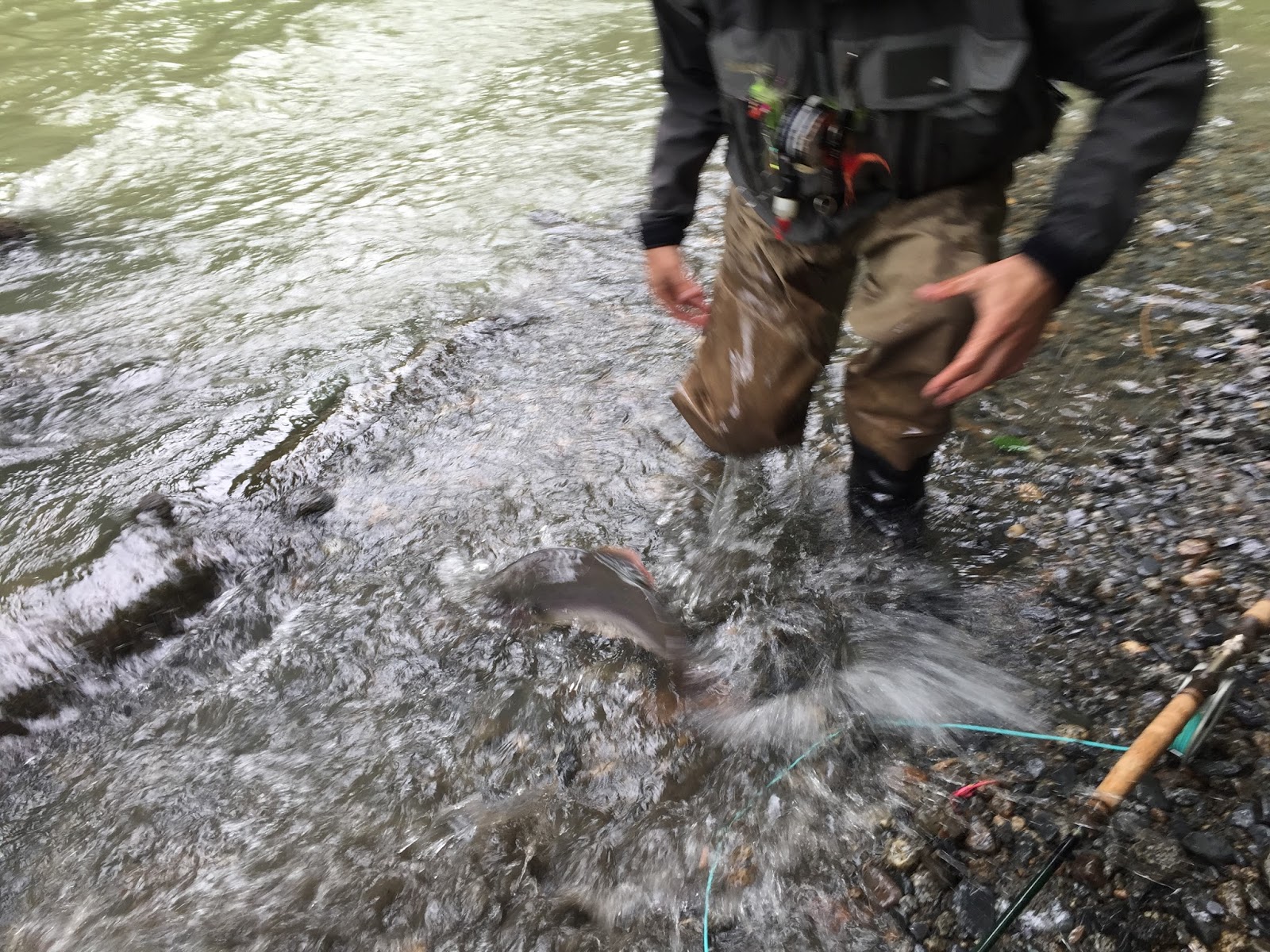
Garrett and I fished north of Juneau - throwing flies at Echo Cove for pinks.  We arrived at high tide, which may not be the best time.  There was the infrequent fish that jumped, indicting there were at least a few in the cove.  I caught a nice one on a purple and pink marabou intruder. I was fishing Garrett's 7/8 weight 10' 6" Beulah switch rod with a Wulff Ambush line - a perfect set up for thsi type of fishing.


A nice chrome female pink caught in the salt.

After only one fish caught - we moved on to Cowee Creek.  There were a bunch of folks spin fishing at the bridge so we wandered down the path along the stream into a real bear garden.  Later found out that there is a mother Brown bear with two cubs in the area.  Cowee was full of pinks, more spent that the one I'd caught in the salt, but Garrett hooked and landed three.  I hooked up with one, but lost it.


Female Pink.


Male Pink salmon, AKA Humpie.

Alaska!

Spawning Salmon, Sheep Creek, near Juneau


First trip to Alaska!  Garrett is flying for Wings of Alaska based in Juneau and we're here for a short visit. These are mostly chum salmon and a few pinks/humpies.  The coho will start running in another week or two.
 

Sunday, 10 May 2015

Reflections on Late Summer Mushroom Hunting


Boletus Edulus + Forest Kit (Cane, Browning Hi-Power and Leica Trinovid 10x42)
Back in the end of August I drove up into the National Forest for the afternoon.    By the time September rolls around it's getting late in the season to find King Bolete mushrooms.   King Boletes are big enough and, with their distinctive brown orange color, I imagined I could do some road hunting for them.  I drove slowly trying to spot them from the truck.  The bright yellow orange Siberian Slippery Jacks (Suillus sibiricus) are also easily spotted from a distance. Suillus are edible though David Aurora describes them in his book Mushrooms Demystified as "thin-fleshed, insipid and slimy". I've tried them and, sadly must agree.   In my experience, they can be indicators for Kings and so a bloom of Slippery Jacks is worth investigating.

Not far into the forest I stopped the truck in a spot where I've been successful before and decided to walk a little.  Almost immediately after getting out of the truck and stumbling around with my cane a bit I found a King Bolete!  I collected it but fully expected it to be worm ridden as they often are by late afternoon.
Driving very slowly and looking hard reveals what otherwise might remain hidden.
Quick success can make a hunt (of any kind) seem too easy.  After finding one bolete, I was certain I'd find many more.  I entertained visions of pounds of perfect boletes, enough to dry some for winter stews.  I worried that I had not brought enough bags with me to carry them all.   I did not find another.  And the further I drove into the forest, hunting for at least one more, the more I became convinced that the one I had found was inedible because of worms.

I drove home the long way, exploring some new country.  At one point, I stopped the truck for a few minutes to admire the view and in another minute saw a grouse head bobbing through the tall grass.  ... and then another and another.  I'd stumbled on a covey of six young dusky grouse.
Dusky grouse in the tall grass.

The covey headed for cover - the nearest tree in the open landscape.
It would be hard to convey the pleasure I got from seeing the grouse.  It had been a wet summer and the tall grass in this country was atypical, I've never seen it this tall.   

*            *             *
When I got home I cut up my King Bolete. There were a couple of small worm tracks in the stem, but it was otherwise perfect.  Sauteed in butter and served together with a nice steak it made for a wonderful  meal.

Simply sauteed in butter with salt and pepper.

Saturday, 13 September 2014

Malcolm Brooks reading in Denver

Malcolm responding to a question at the reading. [Photo: Reid Farmer]
Malcolm Brooks is a friend whose first novel, Painted Horses, has been receiving a well deserved widely celebrated reception. His book has been included on many summer reading lists, he has been featured by Barnes and Nobel in their "Discover Great New Writers" series, and the book is widely receiving glowing reviews. Malcolm's writing is being compared to the best of the best: Hemingway, Cormac McCarthy, Charles Frazier, Ivan Doig,  and Michael Ondaatje, Wallace Stegner, Thomas McGuane, Annie Proulx and others! All favorites of mine - no wonder I loved the book.  Here's an excerpt from a review in Dallas Morning News.
Painted Horses reads like a cross between Charles Frazier’s Cold Mountain and Ernest Hemingway’s A Farewell to Arms, with a pinch of Michael Ondaatje’s The English Patient for good measure. It’s an earnest, romantic novel that seems destined for the silver screen. review by WILLIAM J. COBB, Dallas Morning News.
 I won't say much about the plot except to note that it's a Western novel (with a capital "W") mainly set in 1956 (my birth year) with flashbacks to WWII.  Not only that, but there is a significant character named Caldwell. Malcolm assures me that the character is named for me.

Carlos and I drove down to Denver last Wednesday for Malcolm's reading and book signing at the Tattered Cover.  Steve Bodio flew up from NM for the reading and to introduce Malcolm.   Other Denver friends showed up as well.

Malcolm reading.
Malcolm read one of the most heartbreaking and dramatic pieces from the book. After the reading, Malcolm took questions from the audience. There were some wonderful questions about his process and the origins of the novel. Malcolm's articulate and deeply personal answers captured the imaginations of all of us there.  Aside from the compelling sweeping narrative, Malcom's book reads like a vocabulary of almost lost words, words describing western landscape, horse anatomy, and technical language related to horse tack.  The breadth and depth of Malcolm's experience and research is astounding.


Gathering of the clan: Carlos, OldGunkie, Reid Farmer, Malcolm Brooks, Steve Bodio [photo: Connie Farmer]
And for all of us who think we might just write more if we had the time, Malcolm wrote the book over a period of five years while working full-time as a carpenter in Missoula.  He puts us all to shame.

I took the pig over the door as a very good sign indeed and the menu and food did not disapoint.
After the reading, on Arthur's recommendation, nine friends retired to a fine Italian restaurant Osteria Marco to continue the conversation with food and drink.  I could not resist the Ciccioli Succulent Braised Pulled Pork appetizer and had the Rabbit Roman Gnocchi, Apple-Fennel Braise, Whole Grain Mustard Sauce as a main course.  Wine drinkers among us shared a bottle of red Tuscan wine recommended by the waiter though I do not recall the name.

Our group included:  Arthur (a friend of Steve's with expertise in rare antique military weapons), Arthur's sister, Malcolm, Connie Farmer's sister, Connie Farmer (Reid's wife), Reid Farmer (archeologist and contributor to the Querencia blog), Carlos Martinez Del Rio, Steve, and myself. The food and drink was excellent and then, of course, there was endlessly fascinating and wide ranging conversion; writing and writers (good, bad, and obnoxious), falconry, guns, pigeons, more guns, food, wine, and music. A woefully incomplete list of topics I can recall that were mentioned or discussed included: Annie Dillard, the post-punk band Mission of  Burma, mushroom hunting, Johnny Cash, the eccentric Oxford naturalist Jonathan Kingdon, Remington Model 8 rifles,  Mauser Broomhandles (especially regarding the merits of the 7.63 Mauser cartridge over the 9mm Luger chambering), Annie Proulx, the 1903 Mannlicher Schoenaur rifle, technical details (that were beyond my ken) of evolutionary biology of horses, dinosaurs, birds and lizards.

Our table at Osteria Marco.
A good time was had by all.  I can not imagine anyone who better deserves the astounding success Malcolm is enjoying and the wonderful reception of his exceptional novel.   Congratulations Malcolm!   ... and if you don't have a copy - get one. 

Friday, 5 September 2014

Man Down

Antique Italian photograph of a man off his horse - dated  in pen 8.3.1926 
It's been some time since I posted here.  I spent most of my summer seeing a small army of physicians. They diagnosed an autoimmune condition as the cause of the peripheral neuropathy that has been affecting my feet and lower legs.  The experts will rarely say with certainty what causes this kind of condition, I am sure it is the result of a major viral infection in 2010 caused by Colorado Tick Fever.   For the time being anyway, I am mostly disabled. I'm able to get around with a cane and am wobbly from the drug therapy I am undergoing.  Nerves heal, but even in the best case it will take a year (or more) to regain my balance and strength.  For concerned readers I should note that I maintain what I like to think of as a realistic optimistism.

*                  *                  *


Those of us who spend time in rugged country inhabited by large predators are often too keenly aware of the dangers posed by teeth and claws.  Being attacked by an animal that can kill and eat you is a primal fear dating to the very beginning of human existence.  Statistically, it is the tiny guys, the bacteria and viruses, that present the greatest threat, not the lions and tigers and bears. 

There are a couple of examples that come to mind, one fictional and one not.
Hemingway on safari in 1934
Hemingway's story The Snows of Kilimanjaro is structured around the irony of a seemingly inconsequential event resulting in the most dramatic outcome. Harry dies on safari, not killed by dangerous game but as the result of an infected wound caused by a thorn.  

Egyptologist Lord Carnavon, died from a mosquito bite.
The genesis of the Curse of the Pharaohs rests with a mosquito bite. What could be more inconsequential? The extraordinarily wealthy British adventurer George Herbert, 5th Earl of Carnarvon, financed the expedition to excavate King Tut's tomb in the valley of the Kings.  In 1922 Lord Carnarvon entered the tomb. In 1923 he died in the Continental-Savoy Hotel in Cairo from a mosquito bite infected by a shaving accident.  His death, and others, spawned the legend of the curse on those who disturb the tomb of a mummy.

*                  *                  *

While I was laid up this summer I spent far too much time looking at vintage and contemporary photographs online.  I looked at thousands of photographs but I did not know what I was looking for until I saw it, an antique Italian photograph of a horse and rider going down in a cloud of dust. In a rather stunningly symbolic way it represents my own situation. Man down.

The author with the Man Down photograph.

Friday, 6 June 2014

Swing the Fly - The Voice of Spey


Ran across this excellent (and free) online magazine today http://www.swingthefly.com/.  Just plain honest, unpretentious talk about fishing long rods.

Friday, 30 May 2014

Eating Around / Le Pigeon

Chef Gabriel Rucker at Le Pigeon.
Had a wonderful meal at Le Pigeon last night. Chef Gabriel Rucker was cooking and we sat at the bar giving us a birds eye view of preparations.  Le Pigeon is perhaps my favorite restaurant in Portland.

 I had the Pigeon starter which was served on a plate of cold blood sausage puree, with cipollini and shaved asparagus, sprinkled with egg yolk.   It was rich a rich sauce and the pigeon breast was perfectly cooked medium rare.  I quaffed down a good class of Coteaux du Languedoc -- Podio Alto -- Domaine du Poujol -- '09.  For her starter, P had the Crab and Artichoke Toast with arugula and fried artichokes.  She had a glass of Greek white wine, Roditis/Malagouzia - Petra - Kir-Yianni Estate - ‘12 Amyndeon.  The crab toast was a bit uninspired, but the batter fried artichokes were amazing.  We shared an entree of Corned Lamb Shoulder served on a bed of potato with cabbage cream, huckleberries and horseradish.  I'd never heard of corned lamb but could immediately imagine it.  I asked Gabriel about it.  He said, "I had an idea. I'm not the first to make it and won't be the last."  Like corned beef, the meat is brined for four days and then cooked sous vide for most of a day. To plate the dish they chopped a hunk of the corned lamb and sauteed it in a pan to heat it up. They sliced it, stacked it on top of the potatoes, sprinkled with huckleberries and shredded lots of fresh horseradish on top. The lamb was surprisingly ham like.  It was a really unique dish, the kind of thing I expect at Pigeon.  For dessert we shared a carafe of Stumptown coffee and a Crème Brûlée which also came with a Vietnamese coffee pot de crème with whipped cream, amaretti crumbs.  I have no idea what made it Vietnamese, but it was excellent.


Gabriel Rucker has been nominated for, and has won, numerous awards from the James Beard Foundation, including: Rising Star Chef of the Year 2011, and the 2013 Best Chef in the Northwest.  Thanks for another great meal.

Sunday, 20 April 2014

Blue Winged Olives on the Green

A Rainbow that took a Blackback WD.
The springtime Blue Winged Olive (BWO) hatch on the Green River in Utah below Flaming Gorge Dam can be epic. It takes place in March-April and provides some of the best dry fly fishing in the Rocky Mountain west.    After years of trying to catch the hatch - I finally did on  Easter weekend April 19th and 20th.  Brad could not go, Carlos could not go, Jeff could not go, nor could Mike go; so I went alone.  Glad I did.

The thing about BWO's is that the hatch comes off if the weather gets rough.  Rain or snow and a bit of wind brings on the hatch.  A sunny day and the olives wait. I was lucky enough to get it all, rain, snow and wind. It's simply amazing to see the bugs start popping up to the surface like clockwork when the weather changes. And then the fish start rising, mostly in the back eddies and along the banks where the duns float lazily waiting for their new wings to dry.  If you watch carefully, you notice a single rise, and then a few more. Before long, you're tying on a dry fly watching pod of a dozen or more rising fish in the clear clear water.

Blue Winged Olive dun - nicely matched by a size 18 parachute dry.
On Saturday April 19th I floated the "A" section of the river.  It extends from the dam, 8 miles downstream to Little Hole.  Though I've fished the Green many times, I'd never floated it before.  The raft is a relatively new addition to my fishing arsenal and I floated it "alone" never out of sight of three to five other boats.  On Sunday I hoped to float the "B" section, but the shuttle is expensive and it adds at least an hour to the drive home so I hiked downstream from Little Hole and fished my way back up.

A nice brown 18" that took a BWO dry in shallow water - perfectly hooked in the neb.
On both days I spent the morning throwing nymphs and wets and did very well.  The water near the dam is colder and there is less BWO activity in that section.  More rainbows than browns in that upper section. I fished classic style winged wets on the dropper and a Black Back Wet Dream on the point.  The BBWD took lots of rainbows in the first couple of miles below the dam.  As I got downstream, the winged wets started taking more fish - and the takes on that fly were aggressive.  In one deep run I had a violent thumping take, and was broken off - perhaps the best  fish of the day.

On both days, by late morning, the weather kicked up and the olives started coming off which meant re-rigging to throw a dry fly.  Its been so long since I did any real dry fly fishing it's hard to relate how much fun it is, especially in the clear clear water of the Green.  What I mean by "real dry fly fishing" is fishing to a mayfly hatch, not throwing monstrous foam terrestrials or midges.  The BWO's are small, but not tiny, a solid size 18 is a good match for the hatch.  

A nice brown that took the dry fly from my raft anchored in the current.
I started fly fishing when I was a graduate student at Cornell. There is a popular bumper sticker in the area that says "Ithaca is Gorges". It's a great place to learn to fly fish with many streams flowing down into Cayuga lake. They support terrific runs of landlocked salmon, spawning browns in the fall, and rainbows in the spring. After building competency in basic skills (including a fly tying course offered through Cornell and taught by Lee Multari) I started driving south to fish the Delaware, the Beaverkill, and the Willowemoc. Hallowed waters in the history of American fly fishing.  These rivers and streams support prolific hatches, from early spring until fall, and it was there I learned the practice of fishing the dry fly.  

Walking back toward Little Hole on Sunday, the weather got bad and the hatch came off again.  I was fishing the pool at the base of a wide riffle when I noticed three or four excellent fish feeding on Baetis duns in water so shallow their backs were frequently exposed.  I tied on a dry and on the third or fourth cast was into a beautiful fish hooked perfectly in the neb.  It was getting late and so I headed back to the truck for the long drive home.  I was happy with y success and what better way to end the day.  

As I walked upstream I met two young anglers frantically fishing to a pod of fifteen or more fish greedily feeding on the surface.  The two young anglers had been there for more than an hour, unable to hook-up. They were throwing size 18 BWO dries. I gave them some advice and headed on, and as I moved further upstream I found a similar pod of fish and decided to try for them. Try as I might, I could not get them to take the dry fly that had just been so successful!  I switched flies, eventually trying every fly in my box that remotely resembled the BWO duns so obviously floating on the surface. Nothing worked.  Eventually, I tied on a size 16 parachute sulphur, a fly that was clearly not a good match.  Inexplicably, I hooked up right away.  After that fish, with a long drive ahead of me, I headed back upstream to the truck. As I walked the bank I was engulfed in a flight of spinners.  If I'd had more time I would haves tested my new theory, i.e., that the fish were taking spinners and not the duns.  The ginger hackle on the larger sulphur pattern that had proved successful was a near perfect match for the wings of a spent spinner.   A masking hatch, not the first time I've run into one, and always a revelation to realize what is really happening.


Final fish of the day that was feeding on spinners.


Saturday, 12 April 2014

Winged Wets

"It has been advanced as an argument against the use of the wet fly, that duns and other small insects which drift drift down upon the surface of a stream are never seen by the fish underwater, and that a wet fly is therefore an unnatural object, especially if winged. 'Never' is a big word and I venture to think the case is overstated. I have watched an eddy with little swirling whirlpools in it for an hour together, and again and again I have seen little groups of flies caught in one or other of the whirls, sucked under and thrown scatterwise through the water, to drift some distance before reaching the surface."
Minor Tactics of the Chalk Stream Angler and Kindred Studies, G.E.M. Skues, 1910

Plate from W.-C.-Stewart's book The Practical Angler. 

    The winged wet fly is only uncommonly found in a modern fisherman's fly box.  In the 1950's and early 60's they were standards, but today they are essentially gone.  G.E.M. Skues developed modern upstream wet fly fishing techniques for English chalk streams and accompanying patterns in the early part of the last century.  Chalk streams provide notoriously technical fishing because of the clarity of the water.  They provide an ideal environment that produces abundant insect life and hence large trout.  The Scottish fisherman and writer W. C. Stewart anticipated Skues by more than 50 years, in 1857 he published his book The Practical Angler -or- The Art of Trout-Fishing More Particularly Applied to Clear Water.  I find it astounding to think that Stewart's book was written before the Civil War.  Stewart's book reads as an exceptionally modern account of fishing upstream with the wet fly.

W.C. Stewart and his mentor James Ballie
Years ago I managed to find a fifth edition of the book published in London in 1907 by Adam and Charles Black.  A.C. Black published many of the classic British fly fishing books including Skues' books.  Stewart is famous for his "spiders" which are the ancestors of modern soft hackles.  The plates in my copy of his book [photo above] also show many winged wets.


Some Stewart inspired winged wets for the BWO hatch.
I am tying some flies in anticipation of a trip to the Green below Flaming Gorge reservoir next weekend. We're hoping to catch the famous BWO hatch.  Inspired by winged flies of Stewart and Skues  I have tied a few winged wets.  Stewart's stream flies do not typically sport tails while his loch flies do.  It may be presumptuous to publish my pattern here before I test it - but here it is.
                      BWO Winged Wet
         Hook: size 16-18 Dai-Riki #135
         Thread: brown olive thread
         Body: Golden Olive SLF squirrel spikey dubbing
         Tail: a few fibers from a Wood Duck flank feather
         Wing: light gray tips of Blue Grouse tail feather.


Saturday, 5 April 2014

Trout Fishing in America Terrorists


"One of us had a piece of chalk and as a first-grader went walking by, the one of us absentmindedly wrote 'Trout Fishing in America' on the back of the first-grader."  ... "We watched the first-grader walk away with 'Trout Fishing in America' written on his back.It looked good and seemed quite natural and pleasing to the eye that a first-grader should have 'Trout Fishing in America' written in chalk on his back."  
Trout Fishing in America, 1967 Richard Brautigan 

Portrait of a trout No.1
The rainbow spawning orgy is still underway on the North Platte.  Jeff, Brad and I fished from about noon until 5PM.  The fish eagerly gobbled size 20 or 22 WD40's and a size 18 red midge larva all day long.  The mob chucking eggs  had far less luck than we did.  Of course, there are eggs being dropped by the hens, but the eggs were just not as effective today as the midge patterns.  When an egg pattern finally did prove successful to the downstream group, I overheard excited hollering from the group on the opposite side of the river "Was it one of the ones with a red dot?"  This would seem to be the fine point of egg pattern fishing; red dot or no?

When we pulled up  I talked to a fisherman eating lunch by his truck wearing Colorado plates. I asked him what they were taking - he said that the fishing was tough - so I asked him what they weren't taking.  He replied, "Bacon and eggs."  A rig consisting of a San Juan worm dropper with an egg on the point.  This is the standard  recommendation from the flyshops to the tourists. It does catch some fish, but this is the standard recommendation largely because so many people just don't believe the small flies will work or they think they won't be able to tie them on.  Carry a cheap pair of reading glasses if you must.  To me, an inveterate tailwater fisherman, a size 18 is looks huge a size 20 seems standard. Size 24's are small.

Portrait of a trout No.2
On technique:   A good dead drift can only be beat by a dead drift augmented with the occasional twitch. Most of my takes were on the twitch.  After I showed Jeff the technique he started hooking up consistently. Cast upstream and across.  Keep mending line upstream to establish a good drift. Once the fly is down and the drift is perfect - give the rod the a wiggle and a slight lift to move the fly in the water, halting the drift for just an instant, before  lowering the rod and resuming the drift again.  This is the old Leisenring lift scaled to midge fishing.    The WD40, with it's oversized hares ear thorax, is an emerger pattern and the fish are keyed into the upward movement of the emerging insect. It's a wonderful BWO pattern, but I've found it to be very effective when the midges are hatching.   Many patterns go by the name WD40 (just do a google image search to see them) - the real ones look like Ed Engle's pattern (on page 86) in his book Tying Small Flies.

I watched many of the fishermen (and women) on the river expending huge effort false casting.  You can spot the experienced fishermen because they keep their flies in the water more than they do in the air.  Often, false casting is just unnecessary.  It takes practice to develop a well timed crisp casting stroke, but it is far more effective than the long arm full body casts so many resort to when trying to get a few feet farther out.

Another mistake I saw throughout much of the day was that folks tend to wade right out into the best water. Of course this is partially related to poor casting skills - you spot a fish and can't quite get your fly out to it - so you wade a little deeper.  But often, in response, the fish will just move a bit deeper into the run. So you wade a bit deeper still.  Very quickly, you're standing waist deep in the middle of the run.


Brad Watson with a beautifully spotted  fish that took the red midge larva.
 The river was crowded and I started by moving into an inauspicious looking open slot thirty yards downstream from the next man. I intended to cross the river to fish the less crowded side but I ended up fishing my short beat all day.  I lost count of how many fish I hooked but I counted 17 landed.  All the ones I landed were cleanly hooked in the mouth and released as quickly as possible. On the way home Jeff read the regs and we realized we could have kept six fish apiece.  Had we done so - it might well have caused a riot ... and I would have had to buy finally spring for a smoker.

Jeff with a fish that took on the twitch.


Saturday, 8 March 2014

Wind River Rainbow Orgy


It's a wild orgy up on the Wind River these days; the rainbows are spawning.  When I arrived there were two guys throwing egg patterns to the spawners on the beds.  They eventually got bored shooting fish in a barrel and left as I was getting geared up. I won't fish to the spawners on their beds and so I drifted midge patterns through the deeper runs. This one, the only fish I caught in three hours, took a size 20 WD40.

Wednesday, 26 February 2014

Eating Around / Old Major

3316 Tejon Street - a seemingly unlikely, mostly  residential, neighborhood 

Portland ain't got nothing on Old Major in Denver.  I first read about the restaurant on Hank Shaw's Honest Food blog.  It was one of his guest chef stops on his Duck, Duck, Goose book tour.  I only saw that he was  going to be there after he'd gone.


When I looked at the menus I was sold.

I stopped in one evening around 5:00 or so and ate at the bar. By 5:30 or so the place started filling up, on a Wednesday evening no less.  To start, I had a half a dozen oysters on the half shell. During happy hour they're $2 a piece.  I drank a glass of the house Chardonnay with the oysters; the house wines are made by The Infinite Monkey Theorem which is a Denver winery without a vineyard.   I love the name (and the theorem) of the company, even if I didn't much care for their Chardonnay.  I followed the oysters with a half an order of the Port Shank Stroganoff which is a stroganoff made with braised pork, hand made pappardelle, and foraged mushrooms.  It was excellent and I drank a very nice glass of Pinot Noir with it.  I'm not much of a desert person but the bartender, Raquel, convinced me to have the macaroon with the press pot of coffee I ordered.  It was a rose/lemon macaroon and I was glad I'd listened to Raquel's recommendation.  The pastry chef, Nadine Donovan, came to Old Major from Le Pigeon and The Woodsman in Portland.  Small world.


3316 Tejon Street
720-420-0622


Wednesday, 27 November 2013

A Sportsman's Working Battery

Guns and Gunning, Captain Paul A. Curtis. Penn Publishing Co. 1934.
The notion of a personal working battery for a sportsman is a favorite topic of  unending debate among gun cranks.  There is a lot of classic literature on both hunting rifles and on shotguns. On balance, the rifle literature tends to be American and much of the shotgun literature, though not all, is British.  Classics authors writing about hunting rifles include (in alphabetical order)  Carmichael, O'Connor, Keith, Taylor, and Whelen.  There is a largely separate literature on shotguns by Boothroyd, Brister, Burrard, O'Connor, Keith, and others.   Bodio's Good Guns Again straddles the classification by discussing both.

I first recall reading a specification for a personal battery in Curtis' book Guns and Gunning.  This book is a favorite of mine though it is not often mentioned today - prices for used copies do not indicate it holds much collector value.  Like reading Datus Proper's recommendation that a man should spend a months salary on his shotgun (I have not), Curtis's recommendations for an all-round battery gave me a kind of permission to think in a way I'd not have dared to before reading it.

Considering a battery (and not a collection) is a holistic view that remains surprisingly infrequently discussed in writing.  The question answered by the consideration of the battery is just this: "What collection of firearms does a modern hunter need to participate in the various forms of hunting throughout the season?" Obviously the answer depends on what you hunt, where you live, if you travel to hunt and of course on personal tastes.

For the North American game hunter not planning to travel to Alaska or Africa, Curtis recommends the following minimal battery:
  • Rifles:  a small game rifle [.22 LR],  .a varmint rifle [.22 Hornet], a general service rifle [.30-06]
  • Shotguns: an upland gun [20 GA double], for all round use [12 GA double], a duck gun [Magnum 12 bore or 10 bore]
  • Sidearms: A .22 revolver or automatic and a large frame revolver [.45 Colt or .44-40]

If you are also a target shooter, Curtis provides the following additional recommendations:
  • a heavy barreled .22 target rifle with telescopic sight
  • a Springfield National Match rifle [.30-06]
  • a trap gun [12 GA pump]
  • a target pistol [.22 single shot heavy frame with adjustable sights]
At the end of the chapter Curtis apologizes for the small size of the battery he's selected!
"Remember, I said in the beginning that my ideal battery must be limited to a few guns to meet satisfactorily many needs. When one's battery assumes the proportions of a collection, he perforce becomes a slave to its care and it ceases to be ideal."
*                                   *                                   *

There's an old saying: "Beware the man with one gun."  What is left unsaid is that he certainly knows how to shoot it well.  An alternate approach to the question of a personal battery is based on a minimalist philosophy: a shotgun a rifle and perhaps a sidearm.  After a lifetime of gun trading, Steve Bodio may have reached a kind of perfection in his (current) minimalist battery.


Steve with his small working battery.
Steve has settled on his choices and, thankfully, brought them with him on his recent visit to show off to friends here in Laramie and surrounding environs.

Steve has a British sidelock 12 GA shotgun, a Mannlicher Schoenauer 1903 rifle and a Smith and Wesson model 629 in .44 Magnum.  Not shown in the photos is a Smith and Wesson model 34 kit gun which is chambered for a .22LR.  He of course has other firearms, but these are the ones he brought, and they form a kind of elegant minimalist working battery.


F. C. Scott sidelock, 1903 Mannlicher Schoenauer and S&W .44 Mag. 

The Mannlicher is a model 1903 takedown chambered in 6.5x54 MS.  It has the most elegant factory pop-up peep sight I have ever seen.  The peep is articulated so that when the bolt is pulled back, it lowers into the tang of the stock and as the bolt is pushed back forward it pops back up.  In photos (and I am kicking myself for not taking more of them) the mechanism looks like it might be flimsy, in person it is not - it is astoundingly robust.  The rifle handles like a shotgun - notice the Prince of Wales grip.  I was disappointed we did not get a chance to shoot while he was here.

The 6.5x54 is a very interesting cartridge.  In fact, Curtis himself recommended the 6.5x54 specifically (with the Savage 250-3000 as an alternate) for the hunter who wanted to combine his varmint rifle with a rifle for medium sized game shooting.  The 6.5 shoots heavy for caliber bullets at lower velocity.  This translates to bullets with very high sectional density and thus exceptional penetration.  The 6.5 Mannlicher was famously used (with 160 gr solids) by W. D. M. Bell to kill elephants.  It is an outstanding deer and hog rifle and is not to be sneezed at for elk in the timber when shooting a 140 or 160 grain bullet.  It is interesting that both Jack O'Connor and Elmer Keith agreed that it is an exceptional cartridge. John Taylor was less complimentary.

Steve took the Mannlicher (and the Scott) to show to the rifle maker Nathan Heineke here in Laramie. The rifle has been previously drilled for a side mounted scope and Steve is planning to have Nate put a Griffin and Howe side mount on the rifle.  Nate worked as a gunsmith at Griffin & Howe in NJ for about 8 years and may well be the most qualified person in the country to do the work.  The great thing about a G&H side mount is that the scope is guaranteed to return to zero and, it does not mess up the engraving on the front ring of the action.  With a classic rifle I consider this to be an important feature.  If the rifle had not previously been drilled and tapped for a side-mount it would be a shame to add it but, since it has, adding a side-mount it is more akin to a restoration.

Steve's choice of a shotgun is an Birmingham made F. C. Scott sidelock in 12 GA with original  2 3/4" chambers. It was probably made in 1910.  For British made guns of the period, 2 1/2" chambers were standard.   Fredrick Scott was known for his pigeon guns and this may explain the non-standard chamber size. A description of the gun by Steve from an email:
He (Frederick, called "Frank") was in business from 1904 to 1918 (some say 19). I think he made fewer than a thousand guns. The wood is really nice which doesn't show well-- may eventually refinish. LOP 14 1/2 or a little less to checkered butt; barrels 70 cm (continental--??), chokes 1/4 & F. balance on hinge pin. Slightly more pitch up than BL and slightly shorter, and weighs 6 1/2 instead of 6 1/4 so it took a little practice to mount as well but I find if I hold it on the barrel ahead of the forearm it points very well. I will probably disable the ejectors (remove springs?) because they are no use to me. I think it was all tightened up when re-proofed (for pigeon level loads -- 1 1/4 oz-- which I will NOT shoot).  I think I will never get closer to a London gun. People who loved the AyA can see how superior it is even if they know nothing about guns (and it weighs exactly the same). 
The Scott is a perfect upland game gun (good for NM quail) and will serve for the occasional duck.


F. C. Scott ad from 1910.
For handguns, Steve's S&W revolver in .44 Mag has the lightest single action trigger I've ever pulled. A pound? Steve assured us that  it is a joy to shoot.  He's outfitted both the .44 and the S&W model 34 kit gun with Hogue grips so, disregarding the heft, they have a similar feel in the hand.

*                                   *                                   *

At this point my personal battery is closer to Curtis's recommended selection than to Bodio's.  I think I'd like to fix that, which of course means, more buying and selling which is half the fun.  
Sunday, 17 November 2013

Fall 2013 Deer & Elk Season

Four cow elk silhouetted on the skyline. [photo: copyright Mike Dunn 2006]

There's meat in the freezer, but there the 2013 season has been a bit of a bust for me. I was only able to spent a total of about four or five days hunting and really had no success.  I killed a grouse in thick cover on a great left to right crossing shot, it tumbled to the ground, feathers flying, but I never found the bird, only feathers.  I misidentified what turned out to be a very nice whitetail buck as a doe, until it was too late for a shot.  I never got a shot at an elk - though Brad cleanly killed one of the four I spotted driving out at dusk.

*                         *                         *

Elk populations are up and the seasons this year was more liberal than they've been since I moved to Wyoming fifteen years ago.  Mule deer are another matter.  The populations have been declining for years now and those declines are finally reflected in the hunting regulations.   The general season in local areas here were open less than a week with a bucks only rule, at least three points on one side.  I almost passed on even buying a license and in the end I was only able to get out for one afternoon and had no success.

*                         *                         *

Brad will be surprised by the image at the top because it is almost exactly the image we saw driving out after a long day hunting elk on foot. In Wyoming, you can shoot a 1/2 hour before and after sunset.  I spotted four cow elk and within a minute of the end of legal shooting time.  They stood there perfectly silhouetted against the skyline.  It was dark enough that the stars were clearly visible.  Brad got out of the truck with his .270 and I rolled  forward, keeping the engine running.  The elk calmly watched the truck, certainly believing they were safely cloaked in darkness. They were close, about 80 yards, but  it was a very steep 80 yards uphill. Brad made a perfect heart shot on the leftmost of the four and she went down within 10 yards of where the bullet hit her.  We were able to gralloch her on the spot and to roll her onto the orange plastic toboggan I use for hauling meat.  The hillside was steep enough that with some backbreaking pulling and lifting, we were able to lower her right down into the back of the pickup.  We were back at the house within an hour and a half of the shot.  We quartered her and the meat was hung for a week before we spent a day butchering. 

.


Saturday, 2 November 2013

Steve & Libby Bodio and Montana writer Malcolm Brooks

Steve, Jim and Malcolm.

... and Ataika and Erdos.

Penelope and Libby.

Libby, Steve, Malcolm and Penelope.

Saturday, 27 July 2013

A good day on the North Fork of the Stillaguamish

First Steelhead - caught on the swing.

Dolly Varden - a new species for me.

G with a nice Dolly.

Second steelhead on the swing - same day. Sparsely tied purple and black Intruder.