Showing posts with label WD40. Show all posts

Saturday, 5 April 2014

Trout Fishing in America Terrorists


"One of us had a piece of chalk and as a first-grader went walking by, the one of us absentmindedly wrote 'Trout Fishing in America' on the back of the first-grader."  ... "We watched the first-grader walk away with 'Trout Fishing in America' written on his back.It looked good and seemed quite natural and pleasing to the eye that a first-grader should have 'Trout Fishing in America' written in chalk on his back."  
Trout Fishing in America, 1967 Richard Brautigan 

Portrait of a trout No.1
The rainbow spawning orgy is still underway on the North Platte.  Jeff, Brad and I fished from about noon until 5PM.  The fish eagerly gobbled size 20 or 22 WD40's and a size 18 red midge larva all day long.  The mob chucking eggs  had far less luck than we did.  Of course, there are eggs being dropped by the hens, but the eggs were just not as effective today as the midge patterns.  When an egg pattern finally did prove successful to the downstream group, I overheard excited hollering from the group on the opposite side of the river "Was it one of the ones with a red dot?"  This would seem to be the fine point of egg pattern fishing; red dot or no?

When we pulled up  I talked to a fisherman eating lunch by his truck wearing Colorado plates. I asked him what they were taking - he said that the fishing was tough - so I asked him what they weren't taking.  He replied, "Bacon and eggs."  A rig consisting of a San Juan worm dropper with an egg on the point.  This is the standard  recommendation from the flyshops to the tourists. It does catch some fish, but this is the standard recommendation largely because so many people just don't believe the small flies will work or they think they won't be able to tie them on.  Carry a cheap pair of reading glasses if you must.  To me, an inveterate tailwater fisherman, a size 18 is looks huge a size 20 seems standard. Size 24's are small.

Portrait of a trout No.2
On technique:   A good dead drift can only be beat by a dead drift augmented with the occasional twitch. Most of my takes were on the twitch.  After I showed Jeff the technique he started hooking up consistently. Cast upstream and across.  Keep mending line upstream to establish a good drift. Once the fly is down and the drift is perfect - give the rod the a wiggle and a slight lift to move the fly in the water, halting the drift for just an instant, before  lowering the rod and resuming the drift again.  This is the old Leisenring lift scaled to midge fishing.    The WD40, with it's oversized hares ear thorax, is an emerger pattern and the fish are keyed into the upward movement of the emerging insect. It's a wonderful BWO pattern, but I've found it to be very effective when the midges are hatching.   Many patterns go by the name WD40 (just do a google image search to see them) - the real ones look like Ed Engle's pattern (on page 86) in his book Tying Small Flies.

I watched many of the fishermen (and women) on the river expending huge effort false casting.  You can spot the experienced fishermen because they keep their flies in the water more than they do in the air.  Often, false casting is just unnecessary.  It takes practice to develop a well timed crisp casting stroke, but it is far more effective than the long arm full body casts so many resort to when trying to get a few feet farther out.

Another mistake I saw throughout much of the day was that folks tend to wade right out into the best water. Of course this is partially related to poor casting skills - you spot a fish and can't quite get your fly out to it - so you wade a little deeper.  But often, in response, the fish will just move a bit deeper into the run. So you wade a bit deeper still.  Very quickly, you're standing waist deep in the middle of the run.


Brad Watson with a beautifully spotted  fish that took the red midge larva.
 The river was crowded and I started by moving into an inauspicious looking open slot thirty yards downstream from the next man. I intended to cross the river to fish the less crowded side but I ended up fishing my short beat all day.  I lost count of how many fish I hooked but I counted 17 landed.  All the ones I landed were cleanly hooked in the mouth and released as quickly as possible. On the way home Jeff read the regs and we realized we could have kept six fish apiece.  Had we done so - it might well have caused a riot ... and I would have had to buy finally spring for a smoker.

Jeff with a fish that took on the twitch.


Saturday, 8 March 2014

Wind River Rainbow Orgy


It's a wild orgy up on the Wind River these days; the rainbows are spawning.  When I arrived there were two guys throwing egg patterns to the spawners on the beds.  They eventually got bored shooting fish in a barrel and left as I was getting geared up. I won't fish to the spawners on their beds and so I drifted midge patterns through the deeper runs. This one, the only fish I caught in three hours, took a size 20 WD40.

Saturday, 18 May 2013

A Day on the Green


Leopard spotted brown. 
After working every day but one for the past month, I managed to take a day to fish the Green River on my drive home from a conference in Utah.  The Green River below the Flaming Gorge dam in Utah is a world class fishery.  There are reportedly 20,000 fish per mile and I believe it. The "A section" extends seven miles downstream from the Flaming Gorge dam to Little Hole.I'd planned to fish downstream from the dam access but I abandoned that plan because of the crowd.  Instead I drove downstream to the Little Hole access.  The parking lot there was nearly empty when I arrived at 9:30 AM.  It's the takeout for boats floating from the dam and by afternoon it is filled with trucks towing trailers that have been shuttled down during the day.

It turned out to be a very good day. Saddly, I was a week late for the Blue Winged Olive hatch, though a few olives did come off during the day. Even so, the fish were still keyed in on BWO nymphs, and I caught as many fish as I care to in a day. I know because I lost count. If I had to guess I landed 15 and hooked about twice that many.  None of the fish I landed was under 15" and none were over 20".  All of them took my Black Back Wet Dream.

BBWD tied on a size 20 Dai-Riki #135 hook - black flashback.
I tie this version of the WD on size 18-22 Dai_Riki #135 hooks.

Black Back Wet Dream (BBWD)
Hook: size 18-22 scud/pupa hook
Body:  olive or  brown olive thread
Tail: a few fibers from a Wood Duck  flank feather
Thorax: tan/brown dubbing
Wing Case:  Black Holo-Tinsel

In the pictured fly I used 70 denier brown olive Ultra thread, the thorax is SLF Spikey Dubbing in natural fox color and the wing case is black Holo Tinsel.   It is a synthesis of Mark Engler's original WD (wet dream) pattern with a flashier version of Randy Smith's Tyvek Baetis.  Engler's pattern was renamed the WD-40 by  Umpqua when they commercialised it - so as not to offend delicate sensibilities. I do not share their compuction. Many folks assume the WD stands for "wood duck".  Good marketing at work I guess.  Smith's pattern uses a wing case tied from Tyvek that has been colored black.  Mine uses black holo-tinsel.   Feel free to tie as many as you like, it's proving to be an amazingly effective pattern, but also, consider this post a copyright on the pattern should you want to commercialize it.

An eighteen incher.
The Green is primarily a brown trout fishery although I did catch some nice rainbows too, fat fish. These fish are heavily pressured and can be selective feeders.  The water is extraordinarily clear and good sized fish hang on the banks. You see many many of them as you hike up the trail.  It can be a frustrating experience for the tyro to fish to one of these large trout, clearly on the feed, in shallow water.  There is nothing more satisfying than taking one of these fish.  Once again, I complain that the fly shops are pushing the big flies to novices because so many fisherman are reluctant to fish the small flies.  The green has a good hatch of cicadas and a big black foam fly is a common pattern there.  Later in the summer there is good hopper fishing as well.  The fly shops are starting to push those flies though I did not see one cicada nor did I see any hoppers.


I met a man on the trial who I took to be from Oregon since he talked about fishing to spawning rainbows on the Williamson River. These are fish that run up out of Klamath Lake. He seemed somewhat disappointed with the Green in comparison. He said he'd done well the day before but he complained that he'd had to fish size 20 flies.  When I first met him he was fishing a cicada and when I saw him later had a streamer tied on.  By that time he'd had one hook-up.  Somewhat hopefully, he told me how he'd met someone the day before who frequently fishes the Green and who prefers to tie on an Adams or a Royal Coachman. A size 20 Adams would actually be a decent imitation of a BWO and there is a kind of local beetle with red/orange colouring. So who knows, maybe an Adams or a Royal Coachman would be just the ticket.  I expressed my doubts which prompted him to walk on.

Looking down into Little Hole on my way out at about five-thirty.

The Green is a great river.  I caught it yesterday at an in between stage, after the BWO hatch but before the summer hatches.   I promise myself that next year I will catch the BWO hatch.

Tuesday, 9 April 2013

Wanted: A Blue Winged Olive Hatch

A wild brown that took a BWO imitation.

It's that time of year when the Blue Winged Olive hatch should be on.  I spent Sunday seeking the hatch but did not find it.  I drove around to Six Mile Gap on the Upper North Platte and discovered it was too muddy to fish.  Maybe not too muddy, but muddier that I wanted to deal with.  Lesson learned: check the N. Platte at the State Line Ranch bridge before driving another 12 miles north to six mile gap.  The  muddy run off was from a snow storm that had hit the N. Platte River Valley but did not leave us a drop of snow on the other side of the Snowy Range.  I drove back to fish the Laramie River not far from my home.  The ice is off but the water is clear and low. These are not the easiest conditions for fishing there.  The Laramie is a wild brown trout fishery and can offer fantastic fishing - but just as often, for me anyway, it can be a bust.  In fact, I can not think of another river that has fished as inconsistently for me as the Laramie.

The day was cool and intermittently overcast with fast scudding clouds which occasionally dropped a mixture of rain and sleet and sometimes a rush of snow which was gone in another minute. Textbook conditions for a Spring Baetis hatch.  The Blue Winged Olives are the first mayflies to hatch in the season.  They are magnificent little mayflies with bluish gray wings and olive/brown bodies.  Unfortunately, the hatch was not to be.

I did have a good afternoon.  I caught six (or seven?) beautiful wild brown trout in a bit more than three hours. The largest (shown above) was just under 18" but the fish were more commonly around 14".  All but two of the fish took a WD40 tied on a size 18 DaiRiki #135 hook.  I've been tying the WD40 with a wood duck tail and a body of 70 denier olive/brown UTC thread. Compared to the old standard Uni-thread the UTC thread colors are both nuanced and rich. The thorax is dubbed with SLF Spikey Dubbing in the Natural Fox color.  The wing case is black Holo Tinsel.  The distinctive thing about the WD40 is the oversize "globular" thorax.   Of the two fish that did not take the WD40, one fancied a skinny orange rock worm and another took a gold bead caddis.  I have to say that every time I brought one in on the WD40 I was surprised to see the fish had not taken the more colorful fly of the pair.  The BWO's may not have been hatching but the fish seem keyed into a good imitation of the BWO nymph/emerger.  That has me thinking the hatch is on, I just missed it.


Thursday, 16 August 2012

Wade Fishing the North Platte


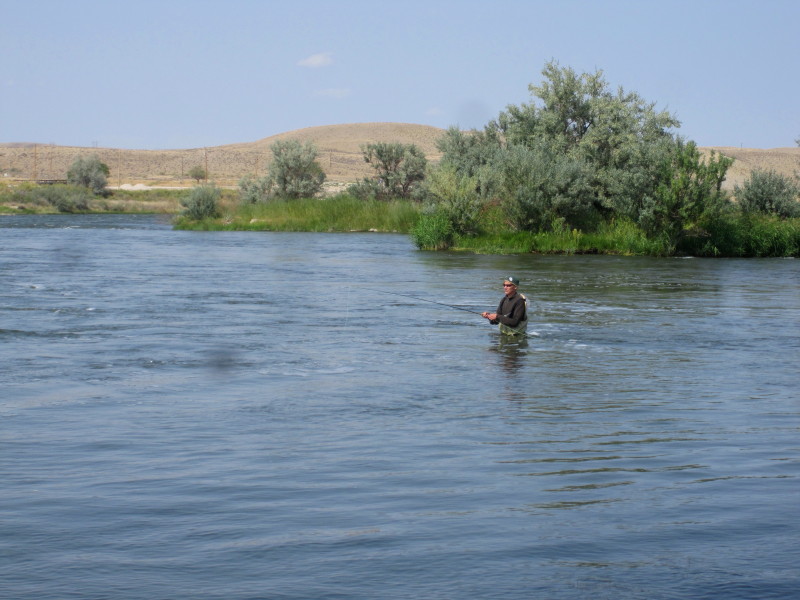
I fished the North Platte river for two days as a last hurrah to summer fishing.  Jeff and I drove up Thursday morning abandoning all manner of important business that could not wait til Monday.  The water was running high out of the Gray Reef dam at 2600 cfs.  At this level wading is a challenge and many people seem to just stay away - which is fine with me,  In my experience, the fishing can be very good when the water is running this high.  

Jeff wading deep below the Gray Reef dam.
I rigged up the Sage 5 weight 11 foot switch rod with a standard two fly nymph rig with a large white thingamabobber strike indicator.  The long rod is pure pleasure on big water like the reef.  I hardly ever bother with a two handed cast there but, when you've waded out to within an inch of the tops of your waders, that extra length means a lot.  The rod is light enough to cast single handed all day and the extra length makes mending a breeze.

We hooked up and caught fish throughout the day.  My largest was about twenty inches, shown in my net in the photo at the top.  That fish, and many others, took a Mercury midge tied on a size 20 Dai-Riki #135 scud/pupa hook with a body of slightly off-white/cream thread instead of the standard white. I should give an update on the pattern I'm using now which is a bit different from the one in the previous post. This has been my go-to fly when midges are on the menu which is almost always.  Jeff had good luck with the fish taking a silver bead headed Zebra Midge tied on the same hook. 

Around five we ate what passes for food at the sadly unbearable Sunset Grill in Alcova. I've sworn this place off more than once and I end up there again and again, it's the only place to eat in Alcova.  The Sunset reeks of stale cigarette smoke which is embedded in the very structure of the place. The food is almost as unbearable as the air. Having previously eaten hamburgers there, I ordered the fish and chips. The freezer burned fish tasted no better than fried breaded cardboard.  In contrast to the Sunset Grill, we stayed in the newer cabins rented out of Sloane's General Store. Can't miss it, it's the only place to buy gas in Alcova. For some reason, they call the cabins The Inn at Alcova but they are commonly known as Sloane's cabins. They are clean, they have fully equipped kitchens and gas grills and run $90 per night for two.  If we'd known we were going to stay there we'd have brought our own food to cook for ourselves.
Bead head caddis pupa pattern proved very effective both days.
After we choked down our dinner we geared up to fish again below the dam until after dark.  Just about the the sun went down, caddis started coming off the water and, in the failing light,  I managed to tie on a bead head caddis pupae.  I started hooking up right away and landed eight fish before I started to get too nervous about wading in the dark through the deep trough that was between me and the shore.  A headlamp would have been an excellent idea.

We met up with John in the parking lot who had driven up from Laramie with his drift boat.  We made plans to meet in the morning to float the river which I've only rarely done before.

Saturday, 21 March 2009

Green River Trip


The Green River, just across the Utah border and below the Flaming Gorge dam, is reputed to have more fish per mile than any other stream in North America. I see numbers as high as 15,000 "catchable" trout per mile for the seven or eight miles of river below the dam. The average sizes are 14 - 18 inches and there are browns, rainbows and less commonly, cutthroat trout. Browns and rainbows dominate with the brown trout perhaps holding a slight majority over rainbows. Most of the fish so clearly visible from the bank are browns; rainbows are still holding in the deeper runs in this pre-spawn period.

Garrett and I fished on Thursday and Friday. It's a bit less that four hours drive from Laramie and we were on the river at 11 having left town just before 7AM. Thursday we fished the upper section just below the dam. The trail down to the river from the upper parking lot is rather spectacular here. With a flow of around 750 cfs the river is wadeable and it is just barely possible for me to cross at certain points. The photo above shows a drift boat passing by as we walked down the trail to the river. We wade fish from the bank and I have never hired a guide. For me, figuring out the fishing is what it is about.

We hooked up with small midge patterns (size 22 gray bodied RS2's and WD40's were hot) and, although we were hoping for a hatch of blue winged olives (Baetis), we saw none. As the day warmed (to maybe around 55°F) the midge hatch came on stronger and some fish started rising so I switched to a dry fly. A size 22 thread midge with a wrap of hackle, no wings or tails, gray body. I did catch one nice brown on the dry fly and hooked up with two more that I did not land on the tiny drys. The water in the Green is just crystal clear and sight fishing is the norm. In almost any good spot you may see ten or more fish lined up along the bank. To sight fish to them you move into position to avoid unnatural drag on the fly from intervening currents and to get the best drift, and cast hoping not to put the fish down. If you have the wrong fly, it will not work. All of these fish have been caught many times each and are highly selective feeders. I caught eight to ten fish all between 13" - 16" and Garrett may have caught twice as many. Garrett fished subsurface midge patterns and caught more fish than I did but I do love to watch a trout rise and take a dry. He was fishing the edges of the deeper and faster runs and hooked up with more rainbows than browns. I concentrated on slower shallower water sight fishing to mostly brown trout. Reflecting on the days fishing I realized that the Baetis hatch was more likely further downstream where the icy water had a chance to warm a bit.

We spent the night in an overpriced room at the Flaming Gorge Resort (discounted winter rates) and ate dinner at the restaurant there sharing a table with a couple of fly fishermen from California. They'd fished the Provo before coming up to the Green and ran into heavy Baetis hatches there. Frank is the flyfishing guy at the Western Sport Shop in San Rafael. It is one of the last great mom and pop outdoor stores in the country with a nice selection of rifles, shotguns, top quality fishing equipment and a really nice selection of new, used and rare sporting books.


Friday morning we drove down to Little Hole parking lot which is seven miles downstream from the dam. Later in the season, this parking lot can get full but there were only three other cars there when we arrived around 9:30 or so. We walked past fish rising in the long flats up to where there is a bit of broken water. We started hooking up on the same gray bodied RS2's and WD40's. Garrett fished that same rig all day long and I believe he must have caught more fish than anyone else on the river that day. He must have caught 30 trout the largest being about 19" or 20" and most being 14" - 16". I caught only a third as many but concentrated on fishing the dry fly. It was a warmer day with temperatures as high as 60°F, though it chilled down when the clouds blocked the sun. Being Friday, there were a lot more fisherman out on the river.

Around 2PM I saw two Blue Winged Olives hatch and the fish got very active. I believe they were taking Baetis nymphs. Garrett was fishing a deeper run below a wide riffle and was catching fish one after another, still fishing his underwater rig with a pair of grey bodied midge imitations. Fishermen walking upstream along the trail on the east bank would stop and watch him. Throughout the day we only rarely saw other fishermen into a fish so his productivity was rather astounding. I finally gave up on the drys after pricking and missing a beautiful rainbow who came up for my crippled Blue Winged Olive pattern in a perfect porpoising rise.

There's nothing like success. I switched to Garrett's rig and started hooking up right away. Missed landing two fish and then landed a nice rainbow. We were near waist deep in the middle of the river and with both of us hooking up we started to attract other fishermen to the run with us. By now it was around 4PM and a second flotilla of drift boats was coming through so it was a socially active scene. I hooked to another rainbow and after a rather extended fight, this one swam between my legs and was holding up under a shelf on a large rock. Rod in one hand and net in the other he swam up and went back between my legs again and against the submerged rock. Trying to move away from the rock I stumbled and gently rolled backwards as I netted the trout. The water temperature was around 40°F. It flowed down over the back of my waders and the icy cold water running down my legs was rather stunning. I released the trout and waded out laughing and cursing. I haven't fallen in a river while fishing for about 14 years. Last time was mid-winter while steelhead fishing on the Salmon River in upstate NY fishing with Peter McDonald. Garrett and I walked back to the truck and dry clothes which were a bit less than a mile downstream It would have been just fine, but I did manage to briefly dunk my camera which now does not work.