Showing posts with label Trout. Show all posts

Saturday, 2 March 2013

Fishing the Wind River Canyon

A nice rainbow caught in the Wind River canyon.
The Wind River starts up high near the summit of Togwotee pass, flows south and east through Doubois WY and then into Boysen Reservoir.  From Boysen reservoir it flows north into the Wind River canyon.  After exiting the canyon, at the "wedding of the waters" it becomes the Big Horn river which flows north through Thermopolis WY and into Montana eventually to flow into the Missouri.  

For about a mile (maybe less) after the Wind flows out of Boysen Reservoir and just before it drops into the  canyon proper, it flows through Boysen State Park.  In the state park a WY fishing license is all you need. Once past the park, the river flows on the Wind River reservation which is the home of the Eastern Shoshone and Northern Arapaho tribes.  To fish or hike in the canyon (or anywhere on the reservation) you need a Tribal Fishing/Trespass license plus a $5 conservation stamp. For WY residents the license costs $20/day, $50/7days and $80/year - non-residents pay $25, $75 and $125.  I purchased a yearly permit at the Fast Lane in Shoshoni.  Last year I tried to buy a permit on a Sunday in Thermopolis - no can do.

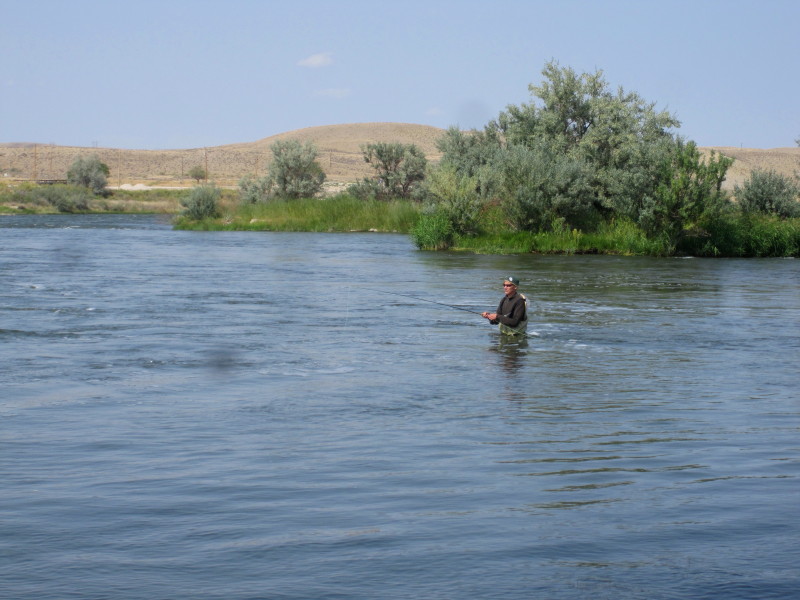
Looking upstream - I am bringing in a nice fish.
Starting around noon I fished a deep run low in the canyon for a couple of hours in the sun, the air temperature was around 50F.  I hooked up pretty consistently on a size 12 bead-head pheasant tail.  In an hour and a half or so I managed to land five nice fish and hooked up with another five I did not bring to hand.    I fished further upstream later in the day - after the sun had disappeared in the clouds - and was frustrated to not hook up again.

A smaller rainbow in beautiful form.


Sunday, 10 February 2013

Superbowl Sunday on the Reef.


The day was indeed warm for early February - the thermometer bumping 50F.  It was breezy all day with an occasional real gust, but never so bad that you felt like it was just crazy to be on the water.   I got there at 10:30 and fished until 4:30.   Six hours of fishing and five of driving.  My rule for a successful day trip (which does not always obtain)  is that there should be more fishing than driving.

The last two times I've fished the reef I've done well with a green leech pattern followed with a midge dropper.  Of course I started with that rig and before long I'd hooked up with a decent rainbow.  Somehow hooking and landing that first fish is always a relief, it's a kind of confirmation, and a day seems to flow more seamlessly after that.

The river is very low (500 cfs) and so, with a bit of boldness, I was able to wade our to a spot I've never made it to before.  From the far side of the dam I was able to follow a rocky edge out to a spot where I was almost directly downstream from the left edge of the dam.  The position was a bit precarious and the flow was a bit stronger and the water a bit deeper out there than I like it in such cold water - but I was able to reach a lot of fish from there. The 11 foot five weight switch rod is just about perfect for this fishing. I can cast it significantly farther than I can a 9' eight weight and certainly far further than I can cast a 9 foot 5 weight.  Once the fly is on the water, the long rod provides amazing line control.  I cast it single handed style all day.  After using an 11 footer, a 9 foot rod feels like a tiny wand.  And it does very nicely in the wind - somehow that extra length allows me to really punch a line into the wind.  It was Superbowl Sunday  and by 2 PM I was the only on the river besides one other fellow who showed up and fished for about twenty minutes before leaving. I spent as much time as I could fishing that spot before I was too cold and needed to warm up in the truck. More than once I'd noticed two larger fish sporadically but actively feeding in shallower water on either side of the main flow.

Although I've seen it many times, there is always something truly astounding about seeing the mottled back of a trout as it slowly emerges from the surface of the water, fin standing high, the fish slowly arcing up and then back down. Not apparently in a hurry at all.  The sun was just right to expose a brightly colored flank just before the fish slipped seamlessly back into the water - quietly disappearing as if it had never been there.

Around 1 PM I  recharged in the truck in full gear with heater running full blast to warm my icy feet. I downed a surprisingly good bacon and egg burrito from Sloane's.  With warm feet and a full stomach I waded back out to my precarious perch on the edge of the main current with the intention of catching those two larger fish.  They were still feeding.  They were undoubtedly smutting; exclusively feeding on midges. I knew that - but my recent successes with the leech pattern paired with conversation in local fly shops had me wanting to take them with anything but a midge.

The loneliness of manning a fly shop counter mid-winter has these guides anxious for conversation, but in those conversations I have often found them disdainful of (my) small fly tactics. In the coarser shop, the recommendation for the reef in winter is  "bacon and eggs" i.e. a San Juan worm with an egg pattern for a dropper.  I'd talked to Trent at the reef fly shop briefly the last time I was up and told him about my (surprising to me) success with a green leech pattern, his response was something to the effect that - "Yes, at this time of year they like something chunky to bite on."  In general, except perhaps on the San Juan, fly shops are generally loath to recommend small flies - or if they do, they are at the bottom of the recommendation list.  Most people don't want to fish a size 24 fly, and even less do they care to tie one on. And besides, most of the guides who man the counters  fish from drift boats where a larger fly might actually do better on average. Tiny flies are most successful when paired with a drag free drift and the occasional induced movement done just so - not always easily accomplished from a moving boat.  A bigger fly is certainly easier to tie on and a single large fly is far less prone to tangle in the wind. As a guide this is important.   At the reef they mostly push an inch long red "rock worm" and perhaps a squirrel strip streamer and an egg.  Of course these patterns catch fish, but not a trout selectively feeding on small midges.


Anyway, I tried almost everything before I tied on what I knew those bigger fish were taking. This was cold work - constantly re-rigging in thigh deep faster water.  Neither of those fish would be fooled by anything larger - at least not by me. I already knew the green mohair leech was of no interest.  Forget a black woolly bugger. I have a beautiful bead head caddis pupae pattern with a pale yellow translucent body.  It was of no interest.  Valadi's worm was unanimously rejected. A small bright red midge larva did not interest them at all, and neither did a scud pattern tied with CDC legs. I tried swinging a white marabou streamer through the water near them and got nothing.  This last failure surprised me because it has proved so effective in the past - even sometimes on smutting trout. 

It was a classic smutting trout situation - they were uninterested in anything but the midges they were keyed on and I knew it the whole time.  Those fish below the dam are hit very hard all year and with the water so low they are  very exposed.  Eventually, feet nearly frozen, I tied on what I knew they wanted. I managed to hook them both on a size 24  foam wing RS2.  (To be fair - I just now see this very fly is near the bottom of the list of recommended flies on the Reef fly shop pages.) In the water, that tiny white dot wing on the RS2 is astoundingly visible.  The larger of the two was feeding in a shallow spot closer to the middle of the river. It was a long cast and harder to get a good drift out there. I only managed to get him to take my fly once - had him on for a second and that put him down for the rest of my day.  I did not see him again. I did managed to the land the other fish after the subtlest take you could ever imagine.  That was very satisfying. It was a rainbow that I will generously say was 18" in length. 

The RS2 really turned out to be the fly of the day - fished upstream or across, dead drift with a occasional twitch to induce the take. This is a variant of the good old Leisenring lift - or something like it - on a fly fished a long way out under a thing-a-ma-bobber. I did not keep count but I believe I hooked and landed a dozen fish and most of those took the RS2.  Interestingly I had a small black bodied silver beadhead midge above the RS2 and it hooked only one fish - an 8" rainbow.  All but one of the fish I caught were rainbows and the one brown was snagged in the belly on a drift through a hole that was obviously holding him and others.

Friday, 17 August 2012

Drifting the North Platte

Blue heron watching / Patient at the waters edge / Speared rainbow wriggles

For someone who mostly wades rivers, floating is a different approach, it provides a different perspective.  Drifting downstream, the path of the river through the landscape unfolds before you. When wading, the river passes you by, flowing around your legs as you work to keep yourself well planted to the bottom.   On a float, each bend reveals something new: an osprey dropping into the river and coming up with a large trout in its talons; a lone buck antelope silhouetted against a deep blue sky; a blue heron patiently waiting for and unwary trout. You'll see many of the same sights while wading but floating streams them to you in continuous succession.

You can't argue with results - nice rainbow hen taken on a WD40 emerger.
And of course there is the difference in the quality of the fishing.  I've always felt that carefully and successfully working a run on foot is the best demonstration of an anglers skill.  Drifting in a boat, with your line overboard, waiting for a hookup, seems rather stochastic.  Hookups come as a surprise.  It seems to me that it has more to do with the skill of the oarsman - who works hard to keep the boat tracking through the best water - than it does with the skill of the angler.  I haven't done much drift boat fishing so maybe I am not tuned to the finer points.

A boat gets you to water you could not otherwise get to but, without some superhuman rowing on the part of your oarsman,  you may not be able to fish it as thoroughly as you might like. In Wyoming we have the absurd law that, even for navigable waterways, the bottom of the river is the property of the landowner.  This means that dropping an anchor is a form of trespassing.  Notoriously, there are posses that patrol the private stretches of water.

John with a nice rainbow early in the float.
In the photo above the rectangular red sign over John's right shoulder indicates private land upstream of the sign.   The opposite side is blue indicating that downstream of the sign the banks are publicly accessible.  Sometimes this is through the generosity of a land owner who has granted access to the public (thank-you) and other times it really is public land - state or federal. Red private - blue public.

They don't call them "greenbacks" for nothing - a nice rainbow being released.

Grousing about access aside - we had a great float. We hooked, played and landed plenty of good fish. Great thanks to Jeff's friend and neighbor John D. Baker.  Aside from being our generous host, John is an artist, a falconer, a master angler, a hunter and a generous oarsman.  I can recommend his website: ravenstudioarts.com where you'll find an array of wildlife art.  I especially like the drawing of the stooping peregrine on the front page of his website. 


We floated from the Gray Reef Access to Government bridge.
We floated from the boat ramp just below the Gray Reef dam to the takeout just below Government bridge, a distance of 10 miles. It was a lazy trip and we stopped and fished from the bank when possible. The float times listed here is six and a half hours for a raft; drift boats times can be faster. John's boat is an RO skiff, which has to be just about the perfect rig for the North Platte. It had plenty of room for the three of us with casting stations fore and aft and with its lower sides it is less affected by wind.  We took our time, shoving off from Gray Reef at about 8:30 AM and getting off the water at Government Bridge at about 5:30. Next time I think I'd take out at Lusby - although we caught fish, the section between Lusby and Government Bridge is slower water and not quite as interesting.  This was John's recommendation - wish we'd taken it.

John with a nice cutbow.
Throughout the day we hooked up on a number of patterns.  I started out with a two fly rig, a bead-head caddis pupa and a  mercury midge on the point. Eventually I switched the point fly to a WD40 and then switched to a dark leech pattern in favor of the caddis pupa. I hooked fish on all the patterns though the WD40 was the most productive pattern. Interviewing some others who came into the ramp after us Jeff found out they'd had a rough day with few fish - couldn't tell it by us.


Thursday, 16 August 2012

Wade Fishing the North Platte


I fished the North Platte river for two days as a last hurrah to summer fishing.  Jeff and I drove up Thursday morning abandoning all manner of important business that could not wait til Monday.  The water was running high out of the Gray Reef dam at 2600 cfs.  At this level wading is a challenge and many people seem to just stay away - which is fine with me,  In my experience, the fishing can be very good when the water is running this high.  

Jeff wading deep below the Gray Reef dam.
I rigged up the Sage 5 weight 11 foot switch rod with a standard two fly nymph rig with a large white thingamabobber strike indicator.  The long rod is pure pleasure on big water like the reef.  I hardly ever bother with a two handed cast there but, when you've waded out to within an inch of the tops of your waders, that extra length means a lot.  The rod is light enough to cast single handed all day and the extra length makes mending a breeze.

We hooked up and caught fish throughout the day.  My largest was about twenty inches, shown in my net in the photo at the top.  That fish, and many others, took a Mercury midge tied on a size 20 Dai-Riki #135 scud/pupa hook with a body of slightly off-white/cream thread instead of the standard white. I should give an update on the pattern I'm using now which is a bit different from the one in the previous post. This has been my go-to fly when midges are on the menu which is almost always.  Jeff had good luck with the fish taking a silver bead headed Zebra Midge tied on the same hook. 

Around five we ate what passes for food at the sadly unbearable Sunset Grill in Alcova. I've sworn this place off more than once and I end up there again and again, it's the only place to eat in Alcova.  The Sunset reeks of stale cigarette smoke which is embedded in the very structure of the place. The food is almost as unbearable as the air. Having previously eaten hamburgers there, I ordered the fish and chips. The freezer burned fish tasted no better than fried breaded cardboard.  In contrast to the Sunset Grill, we stayed in the newer cabins rented out of Sloane's General Store. Can't miss it, it's the only place to buy gas in Alcova. For some reason, they call the cabins The Inn at Alcova but they are commonly known as Sloane's cabins. They are clean, they have fully equipped kitchens and gas grills and run $90 per night for two.  If we'd known we were going to stay there we'd have brought our own food to cook for ourselves.
Bead head caddis pupa pattern proved very effective both days.
After we choked down our dinner we geared up to fish again below the dam until after dark.  Just about the the sun went down, caddis started coming off the water and, in the failing light,  I managed to tie on a bead head caddis pupae.  I started hooking up right away and landed eight fish before I started to get too nervous about wading in the dark through the deep trough that was between me and the shore.  A headlamp would have been an excellent idea.

We met up with John in the parking lot who had driven up from Laramie with his drift boat.  We made plans to meet in the morning to float the river which I've only rarely done before.

Sunday, 31 July 2011

The Madison


We drove north from Island Park ID along the east side of Henry's Lake and up and over Raynolds Pass to the Madison.  We fished upstream from the bridge on the North side of the river.  The south bank is dotted with trophy homes, most with large picture windows looking out onto the river -- kind of makes you feel like you're the entertainment.  I've fished this place maybe a half a dozen times over the years.  Gerry had not been there since the houses were built.  There were other fishermen on the river but it was less crowded than the Fork.   The water was high and off-color and the wind was gusting pretty hard.  Not good conditions. We did not hook up working that north bank (I figured it had already been fished pretty hard that morning) so we decided too drive up along Quake lake to see if we could find where Gerry and his family had camped so often.  As best as we could tell, the old campsite which had been near the confluence of Beaver Creek and the Madison was now part of the lake.

After some lunch we stopped in Kelly Galloup's flyshop at Slide Inn.  I recall fishing at Slide Inn one spring many years ago -- before there was any shop there --  but the grade is still steep there and the river was roaring and it did not appeal.  A enthusiastic college kid was working the shop.  He was brimming over with a summer's worth of new found knowledge and he told us that we need to wait until dusk for the caddis hatch. Until the hatch he recommended fishing a small pheasant tail nymphs.  He liked our chances at $3 bridge.   We drove downstream and parked at the bridge, paying our fee in the metal box.  It was maybe 2PM, still far too early for the evening hatch at 8PM.  We rigged up and started fishing upstream. Almost immediately Gerry and I got separated.

Four golden pheasant-tail caddis larva.

As occasionally happens in flyfishing, I had an epiphany. I thought: "If there was to be an astounding caddis hatch at 8PM, wasn't the river filled caddis larva right now?"  I tied on a pattern representing a cased larva which tied with golden pheasant-tail (a pattern of my own design) and within two casts I had hooked up with a fiesty brown trout.  At one point he ran upstream through a deep opening between two large rocks and then ran back downstream on the far side.  My line was stuck, deeply wrapped around the base of a refrigerator sized boulder.  I was sure I'd lost the fish and was vaguely concerned about retrieving my line.  When I managed to free the line, the fight was back on.  I finally landed him fifty yards downstream from where I'd first hooked him. Based on the fight he'd put up I was surprised to find a buttery yellow brown trout about 15" in length attached to the other end of my line. 

Fiesty brown taken on a caddis larva pattern.

Although I was anxious to share my insight with Gerry, there was a promising unfished bit of run just above where I'd hooked the first fish.   After a few more casts I was firmly attached to another fish, this one was a rainbow and now I knew I had cracked the puzzle. 


I went downstream to find Gerry to share my  insight.  The last time I'd seen him he was below me. He'd apparently leapfrogged past me without me (or him) noticing. When I'd made the 1/2 mile walk back to the truck I realized what had happened.  I walked to the bridge and started fishing up the north bank.  Again, almost immediately, I hooked up with a feisty fish.  As I reached for my net to land another brown trout I heard something plunk into the fast current I was standing in.  I was sure it was my camera, and I frantically tried to move downstream with he current, peering down into the water to try to see what had fallen. Whatever it was, it was lost.  I turned my attention back to the fish still on my line.  I landed the fish found my camera just where I'd put it and took a photograph. It turned out that the half of the the magnetic net holder that was attached to my vest had dropped in the current.  Unable to reattach my landing net, I went back to the truck.

Gerry came walking in rather soon after that.  He had hooked one good fish that took off upstream like a steelhead, but it broke him off.  My nymph rig included a tiny tin shot (size 4) pinched on the line about 2 feet above two of my golden pheasant caddis larvae which were tied about a foot and a half apart on 5X tippet. Gerry was fishing deep with a heavier rig and did not get as many hookups.  It's surprising how seemingly small differences can have such an effect on outcomes.


Madison river brown.
It was a bit after 4PM. We were both tired and hungry so we decided to move on. We debated driving to Ennis and fishing the Madison again the next day.  I love Ennis. But at some point on every road trip, driving further away from home, even only 30 miles, seems too far.  After a brief discussion, we decided to head east and south on to our last destination, the North Platte River at Gray Reef, my home water.  Our path took us to West Yellowstone where we ate dinner.  With at most a couple of hours of light left in the day, we drove in through the West Entrance of Yellowstone. We drove through the park to the East Entrance and on to Cody WY where we spent the night.

Friday, 29 July 2011

Henry's Fork of the Snake

Gerry back on the Fork after a 45 year absence.

Gerry and I decided a real fishing road-trip would be a good idea in late July and, by dog, we did it.

Gerry flew into Denver and I picked him up and drove us up to Laramie. The next morning we drove from Laramie up to Jackson Hole where we ate dinner on the porch at Calico in Wilson.  The Snake in Jackson was high and muddy. We drove up and over Teton pass into Idaho spending the night in Driggs. 

We were on the Henry's Fork above Harriman State Park the next morning.   Gerry had spent his youth fishing the Yellowstone area rivers with his parents: the Henry's Fork, the Madison and the Firehole was their summer home.  For many years they camped for a month and more along the Madison where Quake lake now is.  The lake was formed by a massive earthquake on July 17, 1959.  After the devastating quake they continued to fish the Yellowstone area for a few years but eventually refocused their fishing efforts to trout in lakes in British Columbia.  Gerry had not been back since.

Even though the reputation of the Henry's Fork is not what it once was, it is still a major destination for an international crowd and even with regular reports of poor fishing it is still crowded.

Instructions for "proper release" in English, Japanese, French and Spanish.

The fishing on the Fork is tough and technical.  We arrived on the water a bit late after a leisurely drive up from Driggs and then spent too much time in Lawson's old shop obtaining Idaho Fishing Licenses and some flies.  There were a few PMD's coming off as we walked down river and it looked promising, there were a few Caddis too. But that action turned off shortly after we arrived and neither of us hooked up, nor did we see anyone else hook up.

For me, fishing is not a competitive sport, at least not the way I practice it.  But even so, when I'm not catching fish and no-one else seems to be either, it provides some evidence that it may not be that I am doing everything wrong -- it may be that the fishing is just tough.  

The author in full fishing regalia.

 The evening hatch was more exciting.  We spotted a very large trout methodically rising behind a rock on the far bank. We waded across the river to work the fish.  There were a few other fish feeding as well. We took turns casting to that large riser for more than an hour.  We did not put him down, but neither could we interest him in any of our offerings.  There were sporadic small flurries of BWO's and Flavs hatching through the evening.  At one point I left Gerry to work the large bank riser. I waded out to try a pod of smaller fish working the main current.  I drifted my fly downstream to them and, with most of a flyline out on the water, I hooked up. I lost what was optimistically a 14" rainbow when it jumped. For me, and for Gerry, this spot and stalk style of dry fly fishing is perhaps the most enjoyable of all  and even though we did not hook up we both had a great evening.  In the fly shop the next day we were told that our large fish was probably taking Flav emergers. We both stocked up on a few.

The next morning we fished a mostly non-existent morning hatch to no avail.   We tried float-tubing Henry's Lake -- Gerry's first time out in a tube -- but the wind came up and we caught nothing.  We tried fishing down river at the takeout above Mesa falls, but caught nothing.

On Henry's Lake before the wind came up.

We did work that same fish for a second evening, this time armed with the magic Flav emergers.  Unfortunately, two oblivious blokes walked down the path along the top of the bank just where we were working the fish and put it down!

 That pretty much did it for us on the Henry's Fork, we'd been skunked and we decided to cut our losses and head to the Madison the next day.

Tuesday, 20 July 2010

Slip indicator fishing.

Netting a rainbow that took a chironomid pattern. Photo Chris Knight
Old Flyfish@ mailing list friend Chris Knight passed through Northern CO in late July on a western roadtrip and we arranged to meet at one of the more famous plains lakes in North Park.  Chris and I have fished before in the early 1990's on Skaneateles Lake in upstate NY, mostly we've been email correspondents for a long time.  It was great to see him after many years and to catch up on the doings of other former (and some still current) @Flyfish members and it was a chance to fish a lake I've been wanting to fish for  a few years.

Chris with the ubiquitous fishing cigar.

A few years ago, at the University of Wyoming Flyfishing Symposium, I saw Jack Dennis give a talk about lake fishing.  He showed a video of Brian Chan demonstrating his rather technical methods of fishing chironomids that Chan and others have developed for lakes in British Columbia and eastern Washington.  The plains lakes here in WY and CO have incredible midge populations so the tactics should work here as well, though I  do not known of of anyone who has really figured out how to adapt Chan's methods for the local lakes (and neither did Jack Dennis when he gave his talk.)  Seeing the video Jack showed was impetus for me to buy the Spring Creek Pram I've been using for lake fishing since.

Admiring the effective slip indicator.

The basic technique is based on the slip indicator.   It allows the use of long leaders (30' or more); when you hook a fish, the indicator slides down the line to the fish so you can land them.  Imagine trying to land a fish if you have an indicator preventing you from bringing the fish in closer than 30'.  These long leaders can be necessary to get the fly down to the level where the fish are feeding.

These slip indicators are hard to find and hard to figure out.  In fact, it's been down right frustrating to find any concrete information on them at all.  Check out this video with Brian Chan that claims to show how to use them.  See if you can figure out how to rig one based on his description ( between 18 - 30 seconds in the video); I can't.  Joni, The Utah Fly Goddess has  the only really clear explanation of how to rig one of these that I've seen - it took me a long time to find this. Thank-you Joni.  She also sells them on her web-site.    If you don't know exactly what you're looking for it's hard to find.  Neither flyshop in Laramie has slip indicators nor does the fly shop at Gray reef.  The guys working in those shops "have heard of them" or "had some once" but don't have them now. On our way to the lake to meet Chris, we stopped at the North Park Anglers in Walden.  They had something called the plumbbobber].  It's not the same type of slip bobber Brian Chan or Joni use, but they did come with instructions and I stocked up on these overpriced bobbers in various sizes.

Chris called on the cell phone just as we stopped at the shop and said to "Hurry up!", that the Callibaetis were coming off and the fish were rising everywhere.  When we arrived, Chris was out in his float tube.

Dry fly purist Chris Knight.
  

The lake we were fishing is known for extraordinarily large brown trout and I was hoping to hook up with one. It took me quite a while to rig up and get the pram in the water, and by the time I did, the hatch was over. No matter, I'd come to fish midges deep. I rigged up with two midge pupa patterns hanging fourteen feet below the slip indicator, they were rigged with a small  split-shot to help them get down. I did manage to hook four fish and land three, all nice rainbows, but not the big brown I was looking for. They were all around 15"-17".  Garrett wandered down the bank and hooked up with a few similar sized rainbows, also on a midge pupa pattern fished deep.

It turns out that Chris is what is known as a dry fly purist; apparently he takes after Fredrick M. Halford.  There aren't many left. As far as I can tell, they mostly hang on the Henry's Fork at Harriman Ranch or on the Beaverkill in NY.  Chris had decided before heading west not to taint his tippet with a nymph of any kind.  One of his custom rods is inscribed "Death before strike indicators."  Chris' main objective for the trip was the small cutthroat streams (all apparently named Frenchman's Creek) in central Colorado and northern New Mexico.  I was sorry he wouldn't take the midge and slip bobber I offered and rig up to match the hatch, even if it was 14 feet below the surface. To each his own.
 
After lunch, Garrett took off in the pram.  Chris and I  fished until the wind came up in float tubes; no luck. Chris did catch a nice fish on a dry in the late afternoon after we moved over to the Michigan River to get out of the wind.

Garrett takes off in the pram, the fish are always bigger on the other side of the lake.

When Garrett got back he told us the story of the one that got away, a state record for sure.

Sunday, 3 January 2010

Dredging for Winter Trout

Just back from Oregon, Garrett and I fished Gray Reef on the North Platte. Air temperatures around 28°F, it was overcast early and then cleared up in the late afternoon. We got on the water around noon and fished until the sun set. Amazingly, aside from some guys fishing from a drift boat below the boat ramp there was no one else there when we arrived. Downstream the river was slushy and not much farther down it was frozen. It looked like you might have been able to walk across the Platte four miles downstream at the Government Bridge access.  During the day a pair of fly fishermen showed up and then later a single angler came. None of them lasted too long. The single was throwing a Spey line. There were some duck hunters up on the impoundment.

Garrett was fishing the Beulah 10'6" 7/8 switch rod I got him for Christmas with the matching Elixer line (with no head) and a 12 foot leader, with an indicator, an AB splitshot and a green leech pattern as the main fly and various others for the dropper. He was hooking up all day on the leech pattern, landing around eight fish. I was fishing my Sage 9' 8 weight RPLX with a floating line and a 10 foot leader with an indicator, one or two number 4 split shot and midge patterns. I didn't do as well as he did (as usual) but I did hook up with four fish and landed one; a rainbow about seventeen inches.


The weeds were bad, worse than I remember seeing there. Apparently there was an issue with the dam this fall and the normal yearly flush did not occur. I'm sure the guides and flyshops will deny it but it seems to both of us that the average size of the fish has decreased significantly in the past couple of years. An average size fish below the dam used to measure around twenty inches and often larger; now the average size seems to be more between sixteen and eighteen inches. Garrett did not land one fish that he thought was over eighteen and mine certainly was closer to seventeen inches. Obviously these are beautiful fish and would be considered big most anywhere else, but the average sizes are not as large as they once were. All the hype about Gray Reef being the Big Fish destination in the lower 48 might have something to do with it. In warmer weather the run below the dam is lined with fishermen, five or six to a side, all day every weekend.

I've always though of the reef as a small fly tailwater and have been successful with midge patterns.  Garrett's success using the leech pattern has me thinking about that.  My hookups all came on a size 20 or smaller red midge larva pattern;  a bit of red thread on the hook with a rib of red wire.  My current theory is this: when the fish turned on for about an hour or so around two, they were happy to take my tiny offering.  At the other times, with the near freezing water and their sluggish metabolisms the bigger fly, fished slower and deeper, was just enough more appealing for them to take.  I came home and tied up some leech patterns.

Monday, 13 July 2009

Wild Browns


Good fishing access is tightly held. And really, all good fishing and hunting spots should remain secret; or so I was told by the riflemaker in town when, a few years ago, I pointed out a number of grouse coverts on the map for him and his British visitor (Paul Roberts the well known rifle and shotgun fitter). Well mostly, grouse are where you find them and I didn't give much away hoping for a free fitting. But fishing access is far more limited and unless the spot is already world famous it is best to be discreet. I won't mention location or even the name of the river.

There often is a story (which may or may not be true) that goes with a good spot and which is designed to keep people away. In my experience, the stories are often mostly true: rattlesnakes; dangerous roads; long walks and difficult access; Grizzly bears; mosquitoes; elusive fish and even stories of the crowds of fishermen are all told. For this spot it is the mosquitoes. This is a particularly bad mosquito year all over the northern Rockies because of all the rain we've had. One old timer told me that the mosquitoes haven't been this bad since the 60s. On this river the mosquitoes are always bad, and in a bad year the swarms are just plain absurd. You have to be hardcore to fish with the swarms we encountered. I wore a mosquito headnet most of the time and liberal and frequent applications of deet at least kept them from biting much.


This river has wild brown trout (Salmo Trutta) A fish is wild if they are naturally spawned in the lake or river where they live. A fish is native if they're indigenous; they've always lived in the watershed and were introduced by some natural mechanism. The brown trout was introduced into North America in 1883 from Germany; von Behr Browns. Apparently the introduction was a controversy then and the introduced fish can still controversial be controversial. They displace native fish and there is something that is, well, not quite natural about them. But regarding the introduction of German browns to North America, in 1913 Theodore Gordon wrote that "Many of us can remember how poor our sport was before the first of the brown trout came in." A wild fish may not necessarily be native, but in a river where the environment and bug life is right they provide fantastic sport.

The two most distinctive things about wild fish is their fight and their colors. Trout in heavily fished tailwaters like the the North Platte, the San Juan and the Bighorn may grow to gargantuan sizes but they have all been caught many times before and tend to "learn" to just give in. Wild fish are outraged by the hook. And the colors are spectacular. These particular fish had a distinctive blue spot on the side of the head which you can see in the photos if you click to enlarge them.


I fished with Garrett and Matt. Hoping for some top water action on dryflies I rigged my Winston 9' 4wt rod. You can wade across this stream at the head and tail of most runs and the Winston is a nice size and weight rod to fish it. The rod carries an old Orvis Battenkill Mark III reel made by Hardy in England. It has the spring and pawl drag system so it sings when a fish runs. I'd forgotten what a pleasure it is to cast this rod and to control a running fish by palming the rim of the spool.

The fish were not feeding on the top though there was variously, a caddis hatch, some blue winged olives sporadically coming off, an occasional hefty yellow bodied yellow winged mayfly (size 14) and a spinner fall. We all three ended up fishing nymphs and I had my best luck with a cased caddis pattern of my own design. The center feathers of a golden pheasant tail are spotted and when wrapped on a hook are a perfect imitation of caddis cases from this particular stream. A small green head and this fly is an expressive but virtually exact imitation of the naturals clinging to every rock.

A rather violent thunderstorm blew in and we huddled under willows beside the stream in the downpour while the lighting crashed around us. We were on the edge of the storm. the main body passed upstream from us. After the storm blew over a rainbow appeared in the east we continued to fish, each of us catching a few more. But the runoff from the violent storm quickly colored the stream a deep muddy red until you could not see the bottom in four inches of water. We decided to head home. Sadly this happened just as a rather prolific spinner fall was getting underway. All-in-all I caught a dozen wild brown trout. They were all at least 14" with the largest just under 20", a very good afternoon of fishing.

Sunday, 12 April 2009

Jackson WY, Snake River


Took Peter, a colleague and visitor from Scotland, to Jackson for the weekend and Garrett and Sarah met us there too. Garrett and I got out to fish the Snake for a few hours. It was overcast and warm with the occasional view to north to the Tetons clearing enough for a nice view. The fishing was not great, we each caught a whitefish, not the big trouts were were hoping for. There was a small hatch of midges, I took my fish on a Griffith's Gnat and Garrett fished small nymphs.


We drove home Easter Sunday by heading north through the park and then down to Dubois and through Lander where we had lunch. East of Lander, at Sweetwater Station. is a rather amazing bookstore variously know as Mad Dog and The Pilgrim Books and the Sweetwater Book Barn. I've passed it before but it was never open. A faded sign out front on the highway says "Fresh Eggs Old Books". Rather amazing bookshop and worth a visit. After we left I was rather disappointed to realize I did not take any photos inside ... next time.


Saturday, 21 March 2009

Green River Trip


The Green River, just across the Utah border and below the Flaming Gorge dam, is reputed to have more fish per mile than any other stream in North America. I see numbers as high as 15,000 "catchable" trout per mile for the seven or eight miles of river below the dam. The average sizes are 14 - 18 inches and there are browns, rainbows and less commonly, cutthroat trout. Browns and rainbows dominate with the brown trout perhaps holding a slight majority over rainbows. Most of the fish so clearly visible from the bank are browns; rainbows are still holding in the deeper runs in this pre-spawn period.

Garrett and I fished on Thursday and Friday. It's a bit less that four hours drive from Laramie and we were on the river at 11 having left town just before 7AM. Thursday we fished the upper section just below the dam. The trail down to the river from the upper parking lot is rather spectacular here. With a flow of around 750 cfs the river is wadeable and it is just barely possible for me to cross at certain points. The photo above shows a drift boat passing by as we walked down the trail to the river. We wade fish from the bank and I have never hired a guide. For me, figuring out the fishing is what it is about.

We hooked up with small midge patterns (size 22 gray bodied RS2's and WD40's were hot) and, although we were hoping for a hatch of blue winged olives (Baetis), we saw none. As the day warmed (to maybe around 55°F) the midge hatch came on stronger and some fish started rising so I switched to a dry fly. A size 22 thread midge with a wrap of hackle, no wings or tails, gray body. I did catch one nice brown on the dry fly and hooked up with two more that I did not land on the tiny drys. The water in the Green is just crystal clear and sight fishing is the norm. In almost any good spot you may see ten or more fish lined up along the bank. To sight fish to them you move into position to avoid unnatural drag on the fly from intervening currents and to get the best drift, and cast hoping not to put the fish down. If you have the wrong fly, it will not work. All of these fish have been caught many times each and are highly selective feeders. I caught eight to ten fish all between 13" - 16" and Garrett may have caught twice as many. Garrett fished subsurface midge patterns and caught more fish than I did but I do love to watch a trout rise and take a dry. He was fishing the edges of the deeper and faster runs and hooked up with more rainbows than browns. I concentrated on slower shallower water sight fishing to mostly brown trout. Reflecting on the days fishing I realized that the Baetis hatch was more likely further downstream where the icy water had a chance to warm a bit.

We spent the night in an overpriced room at the Flaming Gorge Resort (discounted winter rates) and ate dinner at the restaurant there sharing a table with a couple of fly fishermen from California. They'd fished the Provo before coming up to the Green and ran into heavy Baetis hatches there. Frank is the flyfishing guy at the Western Sport Shop in San Rafael. It is one of the last great mom and pop outdoor stores in the country with a nice selection of rifles, shotguns, top quality fishing equipment and a really nice selection of new, used and rare sporting books.


Friday morning we drove down to Little Hole parking lot which is seven miles downstream from the dam. Later in the season, this parking lot can get full but there were only three other cars there when we arrived around 9:30 or so. We walked past fish rising in the long flats up to where there is a bit of broken water. We started hooking up on the same gray bodied RS2's and WD40's. Garrett fished that same rig all day long and I believe he must have caught more fish than anyone else on the river that day. He must have caught 30 trout the largest being about 19" or 20" and most being 14" - 16". I caught only a third as many but concentrated on fishing the dry fly. It was a warmer day with temperatures as high as 60°F, though it chilled down when the clouds blocked the sun. Being Friday, there were a lot more fisherman out on the river.

Around 2PM I saw two Blue Winged Olives hatch and the fish got very active. I believe they were taking Baetis nymphs. Garrett was fishing a deeper run below a wide riffle and was catching fish one after another, still fishing his underwater rig with a pair of grey bodied midge imitations. Fishermen walking upstream along the trail on the east bank would stop and watch him. Throughout the day we only rarely saw other fishermen into a fish so his productivity was rather astounding. I finally gave up on the drys after pricking and missing a beautiful rainbow who came up for my crippled Blue Winged Olive pattern in a perfect porpoising rise.

There's nothing like success. I switched to Garrett's rig and started hooking up right away. Missed landing two fish and then landed a nice rainbow. We were near waist deep in the middle of the river and with both of us hooking up we started to attract other fishermen to the run with us. By now it was around 4PM and a second flotilla of drift boats was coming through so it was a socially active scene. I hooked to another rainbow and after a rather extended fight, this one swam between my legs and was holding up under a shelf on a large rock. Rod in one hand and net in the other he swam up and went back between my legs again and against the submerged rock. Trying to move away from the rock I stumbled and gently rolled backwards as I netted the trout. The water temperature was around 40°F. It flowed down over the back of my waders and the icy cold water running down my legs was rather stunning. I released the trout and waded out laughing and cursing. I haven't fallen in a river while fishing for about 14 years. Last time was mid-winter while steelhead fishing on the Salmon River in upstate NY fishing with Peter McDonald. Garrett and I walked back to the truck and dry clothes which were a bit less than a mile downstream It would have been just fine, but I did manage to briefly dunk my camera which now does not work.

Friday, 30 January 2009

Snake River, Jackson Hole


Arrived in Jackson in the afternoon. Just enough time to walk around a bit and grab a bite before heading to the town ski trail along the Snake. The parking lot is on the east side of the bridge crossing the Snake river on the road to Wilson. It is a dog party place; We skied from about 4:30 until almost 6 and people were out in force on a warm evening walking their dogs. The trail has a track and is groomed for skate skiing too. Lots of joggers. Saw three moose. The ski up the river is just shy of two miles one way. Further up river is protected winter range for elk and moose.

When we arrived there were a couple of fly fishermen working the water on a little side stream of the snake just about the bridge. They said they were killing 'em on midges.

The Tetons are magnificent. Dave Pearson and I climbed the Grand Teton in 1993 (or was it 1992?) We arrived in Jackson in late June and there still was way too much snow. We had planned on doing the Direct Exum Ridge, but it was heavily iced and so we did the Owen Spalding route instead. At the Upper Saddle we ran into a guy who was soloing who asked if he could tag along on our rope, which we agreed to. Clouds were scudding by and as we exited the icy cracks to the summit they intensified. I lead up (still roped) to the summit first. And then I felt something on the top of my head, like some one gently scratching my scalp, but through my hat. And then I hear a bit of a humming sound. I realized that I was about to be hit bu lightening. I yelled down to Dave and Georgia I was coming down. I tossed the ice axe and rand down the snowfield off the top to a small rock ledge real quick, stacked some rope under me and crouched down. We were not hit and after the cloud passed we all three dashed to the summit. A few minutes later the same cloud passed over Mt Moran and let loose with many lightening strikes. We only stayed on the summit long enough to snap a photo and then got back down as fast a possible to avoid the next cloud which was approaching fast.


The Tetons are an amazing place.

Sunday, 18 January 2009

North Platte at Grey Reef


Fished the North Platte at Grey Reef with Garrett on Sunday. The weather was supposed to provide spring like temperatures, forecast to get as high as 62°F. Garrett and I have fished at Grey reef a number of times and typically know how to catch fish there. I caught a 27" rainbow there years ago and on Sunday I hooked three and landed two around 18" and Garrett hooked four and landed three. One of his was huge, estimated at 25". He kept a measured 21 1/2" fish at the end of the day and the one he released was significantly larger. The photo above is of the larger fish. These fish proved to be redemption for our failure earlier this month on the South Platte at Deckers Colorado.

Grey Reef is one of the hottest fishing spots in the west and we were not alone fishing there, though it was not crowded by Grey Reef standards. American Angler magazine called it the number one big fish destination in the world. That kind of publicity tends to attract some people. Most of the license plates are WY and CO and there was one from NY. Typically, the fishing is rather technical and it is another situation where tiny flies mostly rule the day. All of the fish I hooked up with took a size 22 or smaller fly. I talked to a few other anglers, none of them hooked up at all. Streamers are also reported to work, but I've never tried them myself.

The day was beautiful if a bit colder than expected. When the clouds cleared off in the afternoon the colors in the river were extraordinary and the day warmed up to around 52°F. There was even a few moments around 2 PM when the midges started coming off, though the hatch didn't last long enough to bring the fish up.

Flows were around 550 CFS which is about as low as it gets. Flows can be as high as 2000 CFS. In higher flows, the rocks where the photos above were taken are spots where we have caught good fish. The river has a dramatically different character with these vastly different flows.

I forgot my camera and the photos shown here were taken with Fuji disposable cameras with prints written to a CD. The photos are not the quality I get with the Canon G9 but they are not bad.